Three discoveries in 45 seconds. Watch the Omega anchor introduce each story with a matching illustration on the studio monitor.
Fictional AI presenter, synthetic narration and AI-generated concept illustrations. Captions included. Created by Don Sol.
In this bulletin: a step toward nuclear clocks; Elias 2-24 b, a young planet still forming; and crystalline building blocks for photonic chips. These are research findings, with practical applications still under development.
Which discovery should we explore next? Bring a question, a sketch, or an idea to the science roundtable.
Read the tour, or choose Listen to hear all five stops.
STOP 1 OF 5
Welcome to Omega Science News, created by Don Sol. Start with one question that catches your attention. The Daily Science Signal brings you discoveries, illustrations, and links to the research. Read at your own pace, or choose Listen. We explain what the evidence shows and where questions remain.
Our public Facebook group is the shared discussion room. Posts and comments there are publicly visible.
Make a starting note
Choose a prompt, add your thoughts, then copy your note into the conversation. Nothing is posted from this box. Your draft clears when you leave or reload this page.
Challenge ideas respectfully. Link evidence when making factual claims.
Separate observations, inferences, and ideas still being tested.
Share work you own or have permission to share. Keep personal details private.
Experiments need a safe method. Ask for help before trying unfamiliar equipment or materials.
Science, stories, and The Arc
Science discussions follow evidence. Conversations about The Arc welcome interpretation, metaphor, and personal reflection. Say which kind of contribution you are making.
Fresh discoveries. Carefully prepared. Served with wonder.
Every day, the world of science brings something new to the market: discoveries, experiments, unexpected connections. Those are the ingredients.
What happens next is where the craft begins.
At Omega Science News, creator and host Don Sol brings a chef’s care to science storytelling—selecting promising stories, examining the evidence, and bringing complicated ideas into focus through everyday analogies, vivid illustrations, and hands-on exploration.
The goal is to give you something that stays with you: an idea you understand, a connection you can explain, a question you want to explore.
Our recipe calls for visible sources, honest uncertainty, and imagination grounded in reality. Every analogy should illuminate the science while making its limits clear.
We’re working to set a new gold standard in science storytelling—and earn that reputation, one carefully prepared story at a time.
Pull up a chair. Bring your curiosity.
Wonder. Observe. Discover.
New here? Open the welcome guide
Ω Your starting point
Your guide to Omega Science News.
I'm your guide to Omega Science News. Follow a question through a story, a video, a hands-on activity, or a conversation. You'll find clear explanations, pictures, source links, and room for your own curiosity. Pick a path, or let me show you around.
Daily Science Signal · Wednesday, September 16, 2026 Host: Don Sol · America/Indiana/Indianapolis Main releases: September 14–15; publication context: September 9–11. LZ watch: September 1 background. Research cutoff: September 16, 2026, 06:21 AM EDT (UTC−4)
Welcome to Omega Science News Explorer Desk, with Don Sol.This is your Daily Science Signal for Wednesday, September sixteenth, twenty twenty-six.How do we turn a faint signal into knowledge?Today we visit a stellar nursery, a particle collider, the overlooked machinery of brain cells, and a laboratory extracting hydrogen.Then we check an underground mystery whose answer remains unknown.
Five AI-generated conceptual illustrations accompany this edition. Original research images and figures are available with the stories.
Ready. Resume restarts the current sentence.
01 / Space · [T] Observations + estimated masses
Webb finds worlds at the small end of star formation
AI-generated illustration · Conceptual brown dwarf in a stellar nursery; not a Webb observation.View the source image or research figureIC 348, Webb NIRCam; infrared wavelengths mapped to visible colors. Credit: NASA, ESA, CSA, Kevin Luhman, Catarina Alves de Oliveira; image processing: Mahdi Zamani.
How small can a star-like object be?NASA's September fifteenth Webb release describes brown dwarfs in IC 348, about a thousand light-years away, with estimated masses down to roughly twice Jupiter's.NASA identifies them as the least massive brown dwarfs yet known.
Brown dwarfs cannot sustain the hydrogen fusion that powers ordinary stars.Webb combined infrared images taken in 2024 with spectra collected in 2025.A spectrum spreads light into wavelengths, giving astronomers more clues than brightness alone.
One of the lightest objects shows excess infrared emission consistent with a surrounding disk.That makes the system interesting for studying how small objects form, but it is not a planet detection.The mass estimates depend on models, and the unusual hydrocarbon signature in the faintest objects still needs an explanation.
Sources and status: NASA release · September 15, 2026. Institutional report read; observations from 2024–2025.
02 / Particle physics · [T] Strong evidence, conditional test
The Higgs leaves a quantum signature in its debris
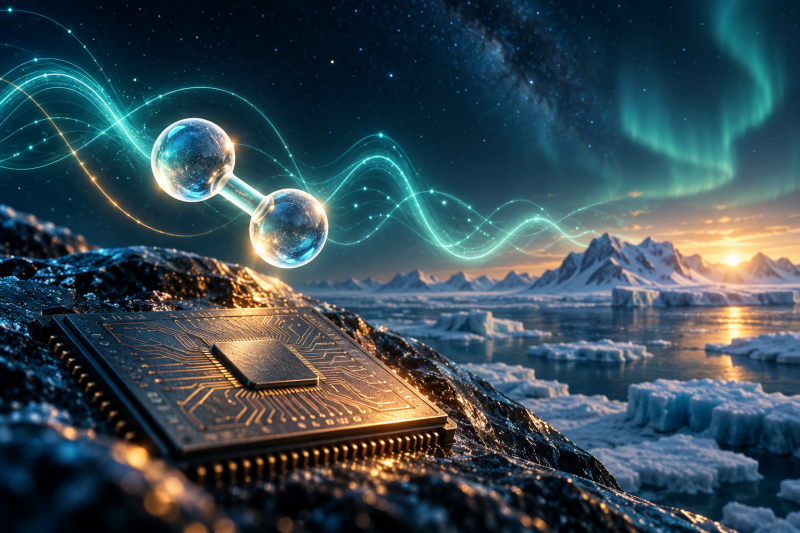
AI-generated illustration · Conceptual collider and particle tracks; not an ATLAS event display or an entanglement diagram.View the source image or research figureActual analysis figure: blue is the entangled model, orange the non-entangled model; the black line is the observed statistic. ATLAS Collaboration/CERN, Figure 6; CC BY 4.0. Unmodified.
Particles can vanish before a detector ever sees them directly.ATLAS researchers reconstruct pairs of Z bosons from the four electrons or muons produced after a Higgs boson decays.The directions of that debris carry information about the parent particles' quantum spins.
Think of reconstructing a brief encounter from the paths left afterward.The team compared angular patterns with entangled and non-entangled descriptions.Its more sensitive test disfavors the tested non-entangled hypothesis at 4.7 standard deviations, under several Standard Model assumptions.
This is strong evidence for entanglement between massive bosons, not a discovery of a new force.The journal publication appeared September eleventh; the preprint dates to March.Entanglement here is a property of the joint quantum state, not a channel for sending messages faster than light.
03 / Neuroscience · [T] Human tissue + laboratory follow-up
The brain’s parts catalog gains a thousand small entries
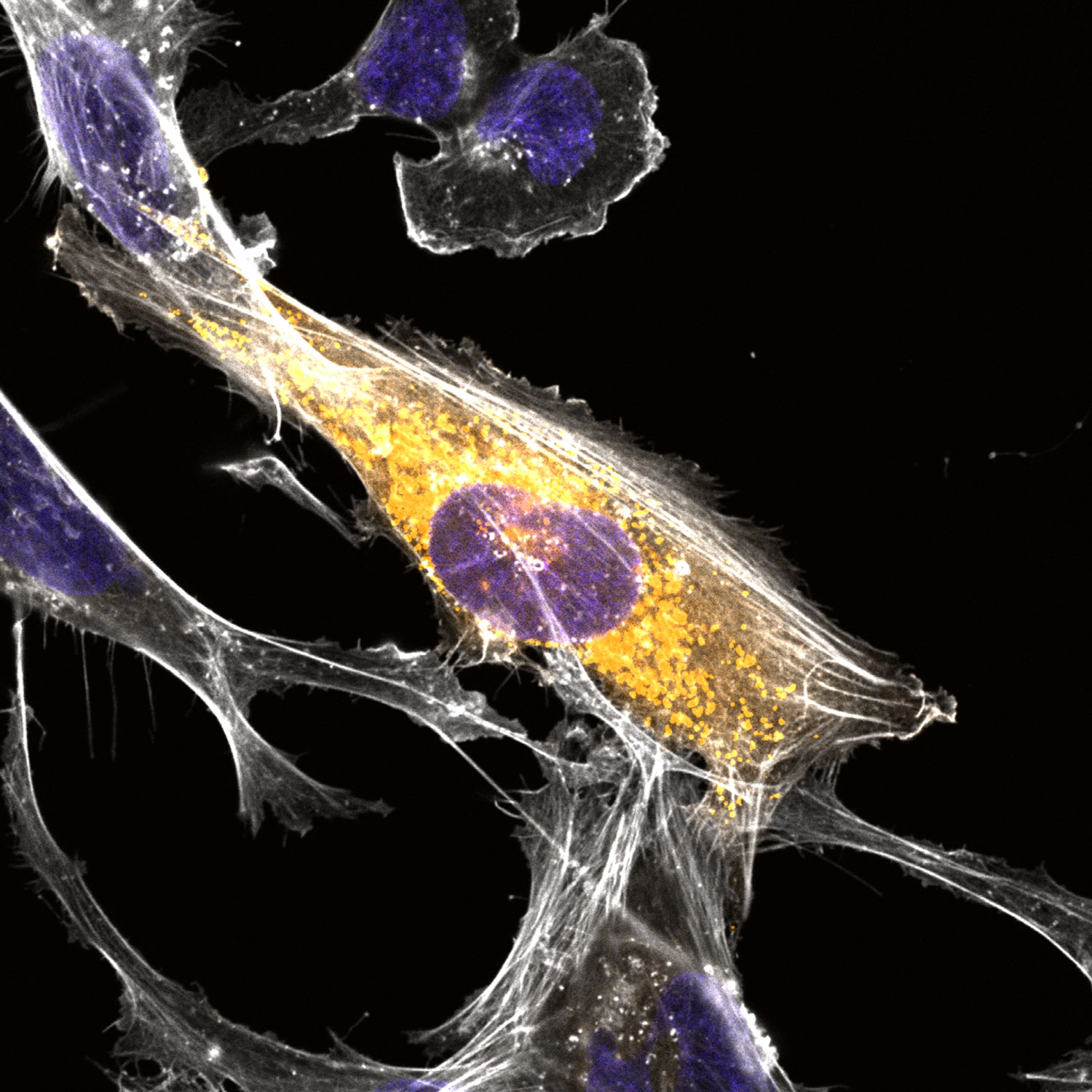
AI-generated illustration · Conceptual cell and microproteins; not microscopy, a diagnostic image, or evidence of a treatment.View the source image or research figureResearch microscopy: an uncharacterized microprotein in orange, nuclei in blue. Credit: Salk Institute. This is a cell image, not a diagnostic brain scan.
A parts catalog can miss important machinery when it leaves out the smallest components.Salk researchers revisited data from human frontal-cortex tissue and identified 1,067 previously uncharacterized microproteins, short proteins often missed by conventional searches.
Computational predictions were checked against mass-spectrometry evidence from protein fragments.Many microproteins appeared at different levels in tissue from people with Alzheimer's disease.The atlas gives other researchers a list of candidates they can investigate.
In a laboratory follow-up involving microglia, the brain's resident immune cells, removing a microprotein-making gene impaired mitochondrial function.Mitochondria help supply usable energy to cells.That experiment supports a cellular role, while the human tissue findings show associations.Whether the microprotein contributes to Alzheimer's disease, or could become a useful treatment target, remains unknown.
04 / Energy + engineering · [T] Laboratory demonstration
Electricity helps unpack hydrogen from ammonia
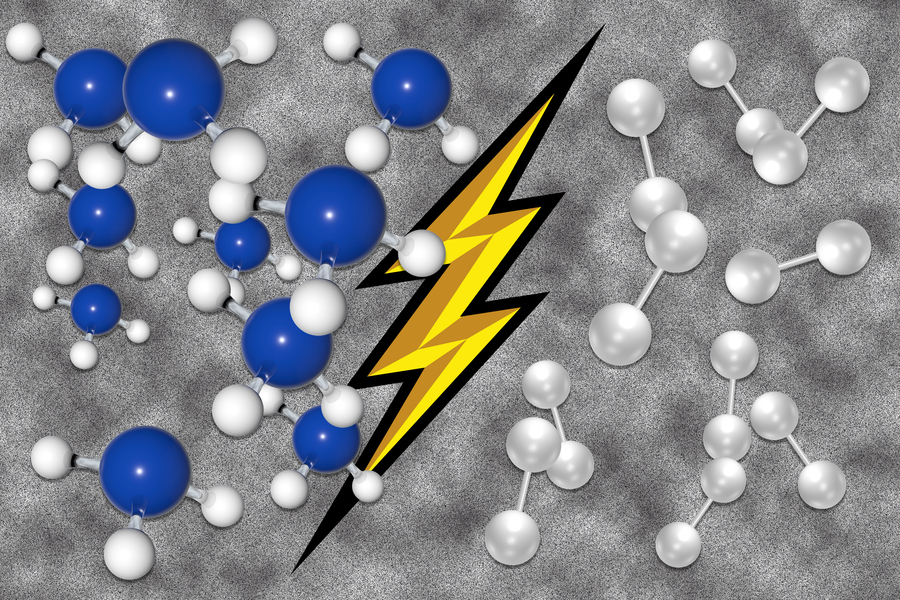
AI-generated illustration · Conceptual hydrogen laboratory; not a photograph of the MIT apparatus or researchers.View the source image or research figureConceptual illustration, not apparatus: Christine Daniloff, MIT; iStock. MIT image-use terms.
Ammonia can carry hydrogen in a form that is easier to transport.The challenge is unpacking it efficiently and delivering hydrogen clean enough for demanding uses.An MIT study published September ninth combines chemical breakdown with electrically driven separation.
A palladium membrane selectively passes hydrogen while keeping other mixture components behind.Pulling hydrogen away also helps the reaction continue, like clearing finished parts from a production line.MIT reports operation around 200 to 300 degrees Celsius, compared with temperatures above 500 degrees for conventional high-rate ammonia cracking.
The laboratory system produces a concentrated hydrogen stream without a separate downstream purification step.Its potential is a simpler route from a transportable carrier to usable fuel.But palladium is expensive, and scaling remains work in progress.Commercial cost, durability, and whole-system energy performance at scale remain unknown.
Sources and status: MIT report and Zeng et al., Nature · September 9, 2026. Report read; full paper unavailable to this review. Seven-day context.
Previous edition · September 14, 2026 · Hidden Pathways
Ω Omega Science News · Explorer Magazine
Hidden Pathways
Daily Science Signal · Monday, September 14, 2026 · Hosted by Don Sol
AI-generated cinematic artwork throughout this edition · Conceptual reconstructions, not photographs of the reported observations.
Welcome to Hidden Pathways, the September fourteenth edition of Omega Science News Explorer Magazine. Twelve reports connect worlds, molecules, living cells, ancient animals and the sea. Each story asks the same practical question: what trace lets us detect a process that cannot be watched directly?
Ready to listen.
Opening signal
Science rarely sees a hidden mechanism directly. It measures a phase shift, a scar, a chemical ratio, a molecular shape or a biological response, then tests which explanation best fits. In this magazine, confirmed measurements are separated from interpretation, and two developing reports are marked as research watch items.
Department I · Forces and Worlds
PUBLISHED PAPER
1. An atom follows two gravitational paths
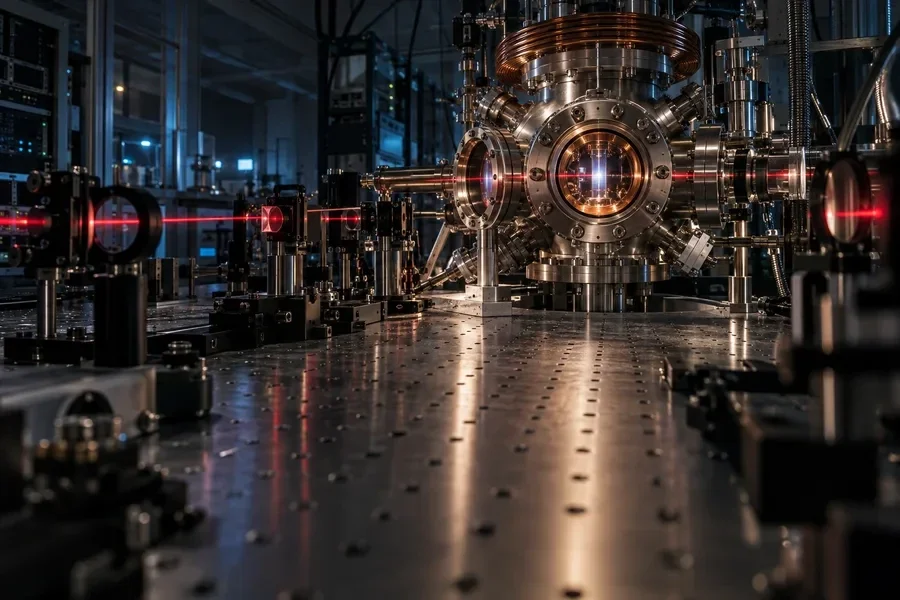
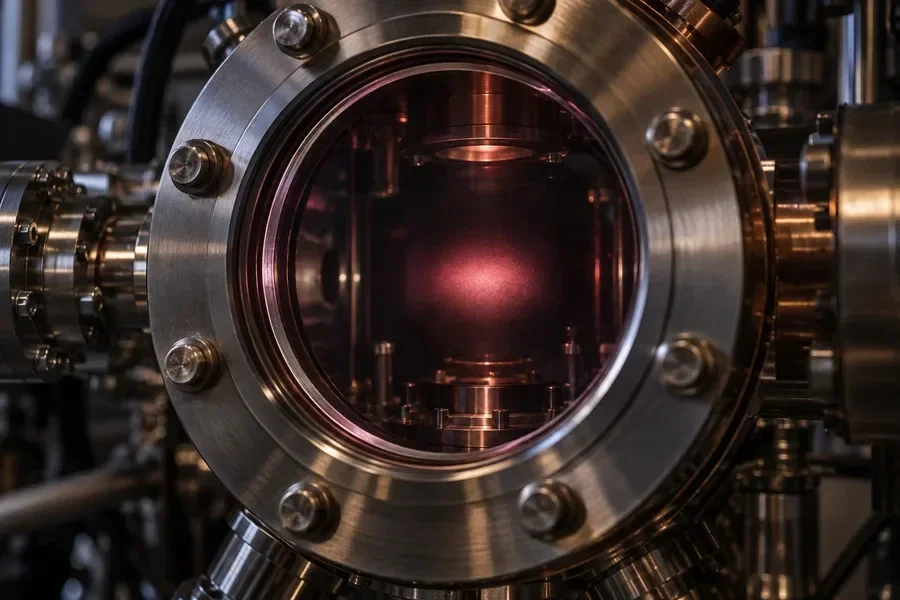
AI reconstruction · An ultracold-atom laboratory; not the study’s apparatus.AI reconstruction · A cold atom cloud imagined through a vacuum-chamber viewport.
Researchers cooled about twenty thousand rubidium atoms and used a Quantum Galileo Interferometer to compare a magnetically held matter-wave path with a freely falling path. The recombined waves developed a phase difference with the predicted time dependence. This is a precise quantum test of free fall. It does not prove that gravity itself is quantized and it is not a complete theory of quantum gravity.
Reality anchor: The measured result is a relative phase shift; the wider meaning remains an interpretation.
2. Mercury may have shrunk more than its visible wrinkles reveal
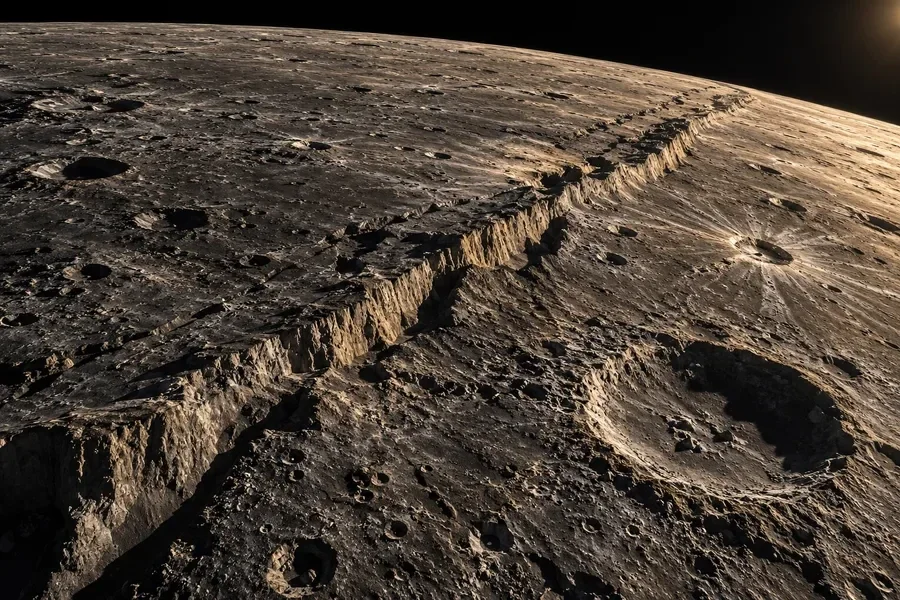
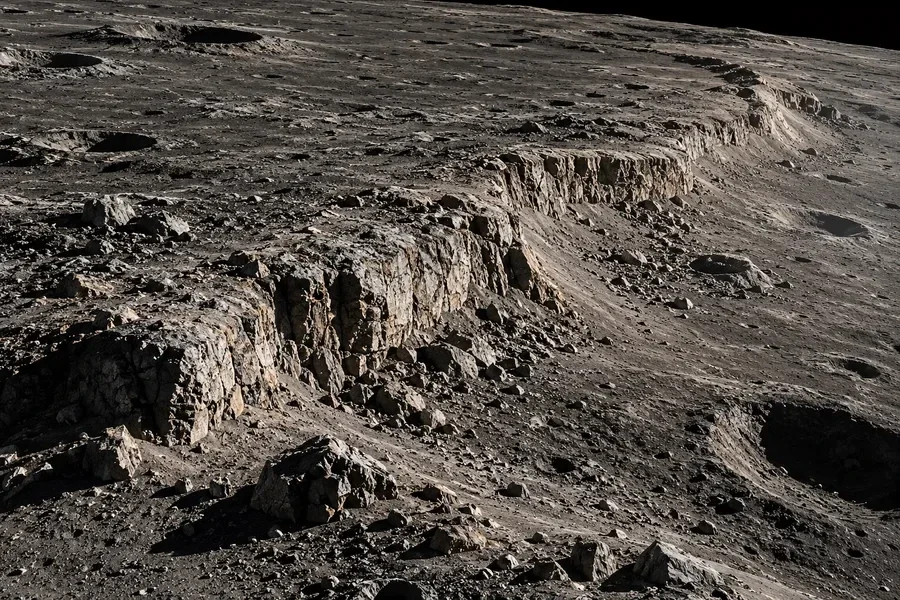
AI reconstruction · Mercury’s cratered terrain and a long contraction scarp.AI reconstruction · Rough ejecta and an ancient rocky scarp; not mapped topography.
A global roughness map made from MESSENGER topography shows that mapped shortening structures are less common in rough regions. Crater ejecta and background relief can conceal older scarps. Correcting this bias raises inferred radial contraction by roughly ten to thirty percent, although the paper says the cause of the anti-correlation is not uniquely determined.
Reality anchor: The robust observation is fewer identifiable scarps in rough terrain; the correction is model-based.
AI reconstruction · A Mercury mission flyby inspired by BepiColombo; spacecraft details are approximate.AI reconstruction · Solar plasma and distant Mercury; scene and scale are conceptual.
During a close Mercury flyby, BepiColombo’s SIXS instrument measured energetic electrons and protons associated with solar activity while the spacecraft passed about one hundred sixty-five kilometers above the surface. Mercury has no thick atmosphere, so incoming particles can directly alter surface material and stimulate X-ray emission. The flyby provides a close-range sample, not yet a complete global climate of Mercury’s particle environment.
AI reconstruction · Two DNA duplexes and ions; molecular geometry and colors are illustrative.AI reconstruction · An atomic force microscope probing a liquid sample; not the study’s instrument.
Atomic-force microscopy in liquid and molecular simulations showed short DNA duplexes aligning groove to groove in the presence of divalent ions. The images support the long-proposed electrostatic zipper model, in which positive ions help overcome repulsion between negatively charged DNA molecules. These were controlled molecular systems, not direct movies of chromosomes inside living cells.
5. A molecular additive strengthens a graphite interface
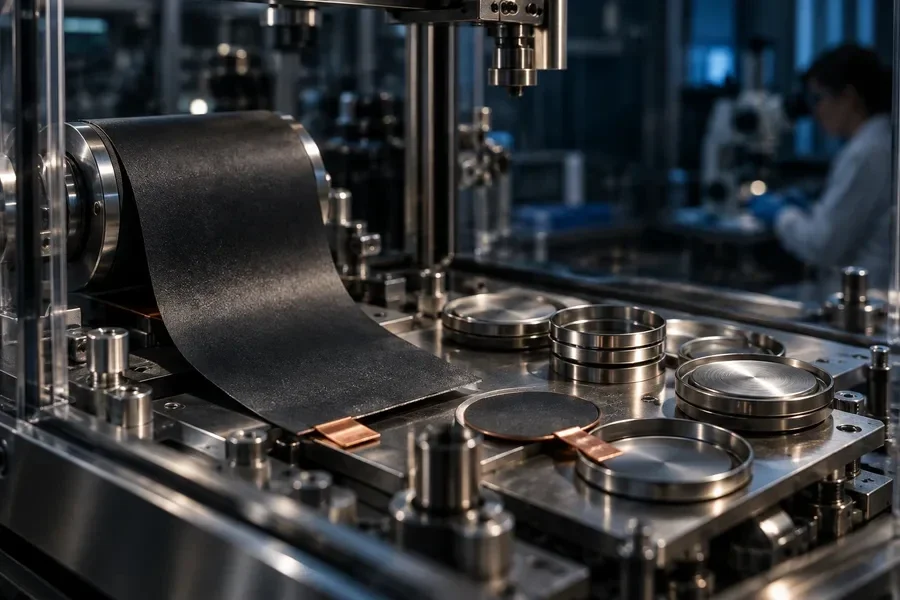
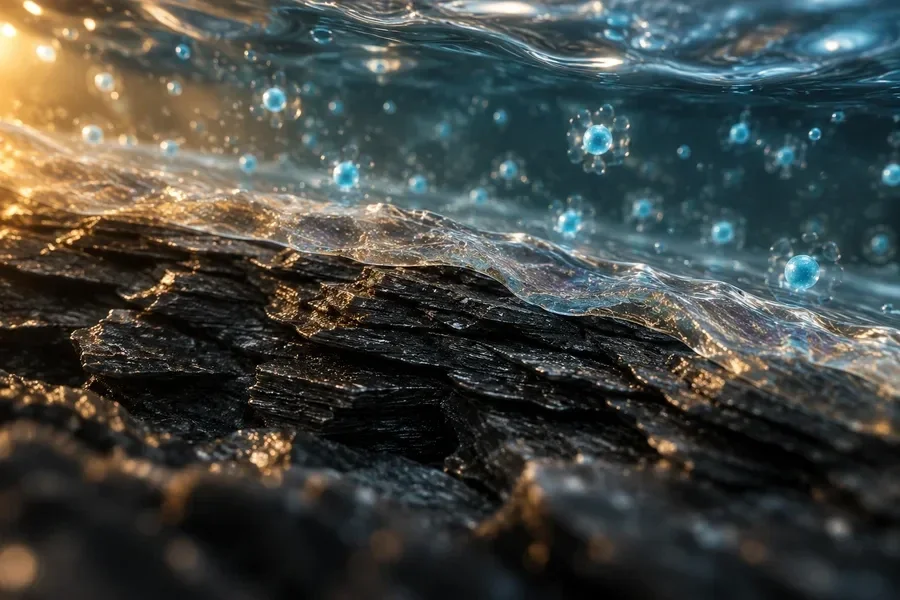
AI reconstruction · Graphite electrodes and laboratory test cells.AI reconstruction · An imagined graphite–electrolyte interface; not an exact chemical structure.
A fluorinated imine electrolyte additive called F P T I promoted a denser protective solid electrolyte interphase on graphite. In lithium-versus-graphite half-cells, formulations containing two and four milligrams per milliliter retained eighty-nine point four and ninety-five point six percent of maximum capacity after one thousand cycles, compared with sixty-two point seven percent for the reported control. Full commercial cells still require validation for safety, temperature and manufacturing.
6. A lipid transporter is caught with cargo inside
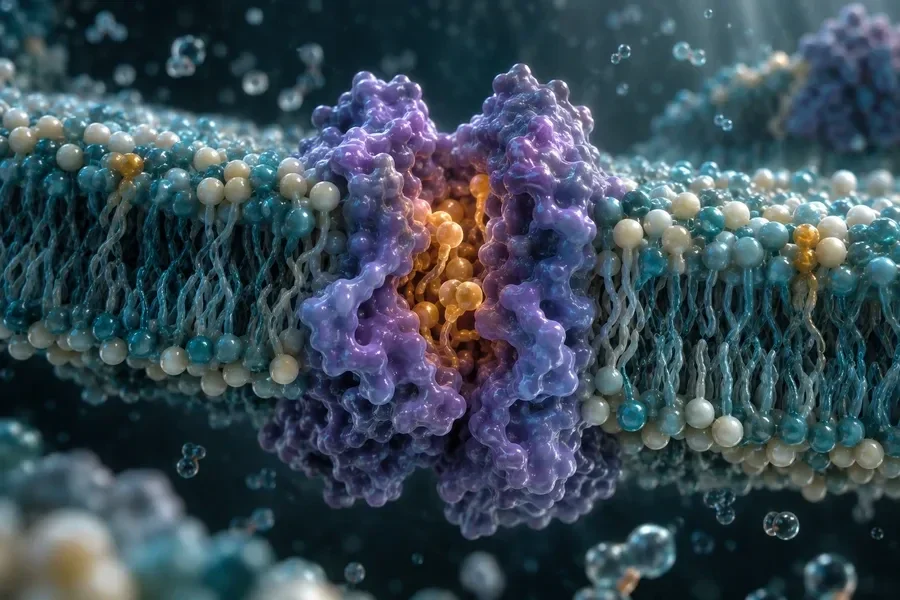
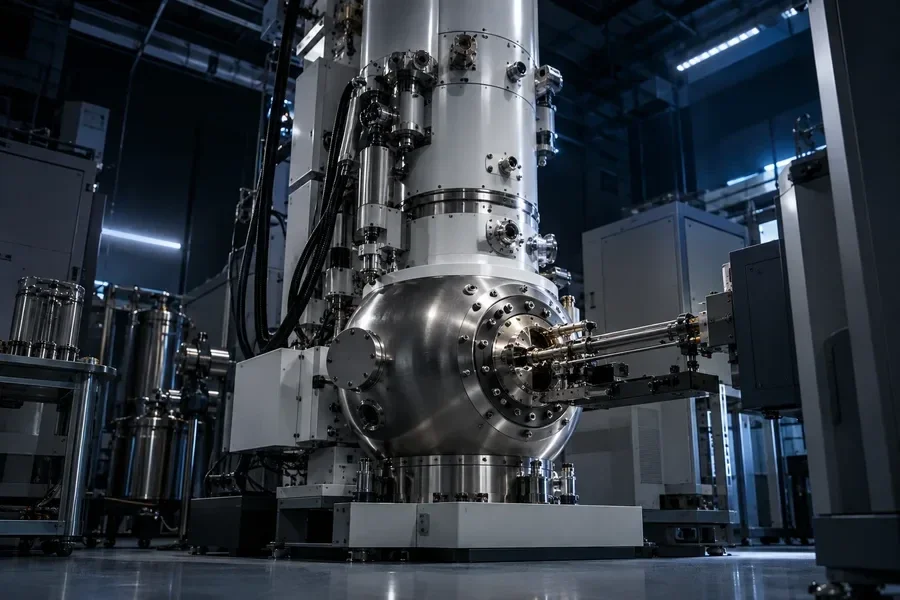
AI reconstruction · A lipid transporter within a membrane; not the measured MFSD2B structure.AI reconstruction · A cryo-electron microscopy laboratory; not the researchers’ actual facility.
Cryogenic electron microscopy resolved human M F S D two B bound to sphingosine-one-phosphate at about three angstrom resolution. The signaling lipid sat deep inside the transporter, where charged amino acids help recognize its polar head. Biochemical tests supported the structural model. The snapshot is a mechanistic map, not a drug, and it does not reveal every stage of transport in living tissues.
7. Short-range brain wiring adds nuance to cognitive aging
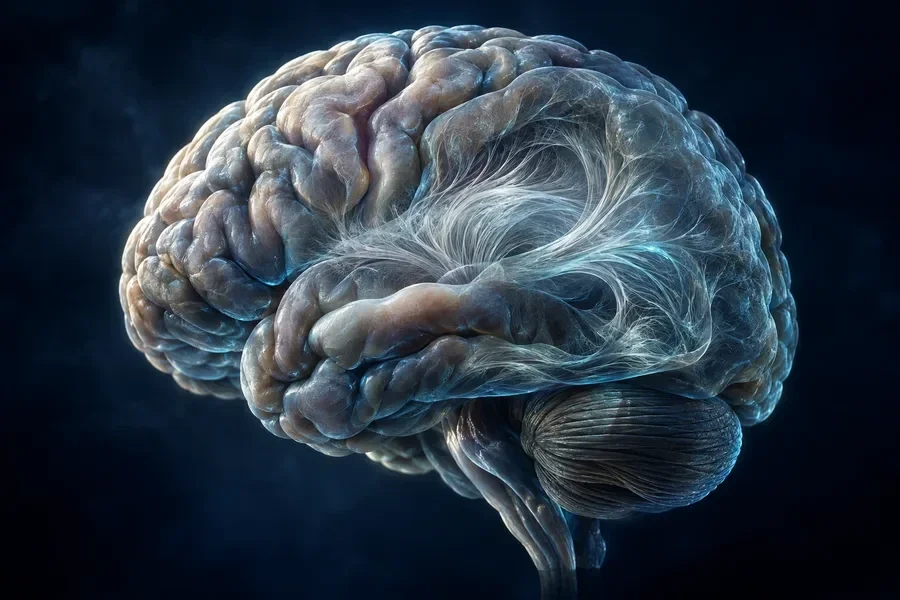
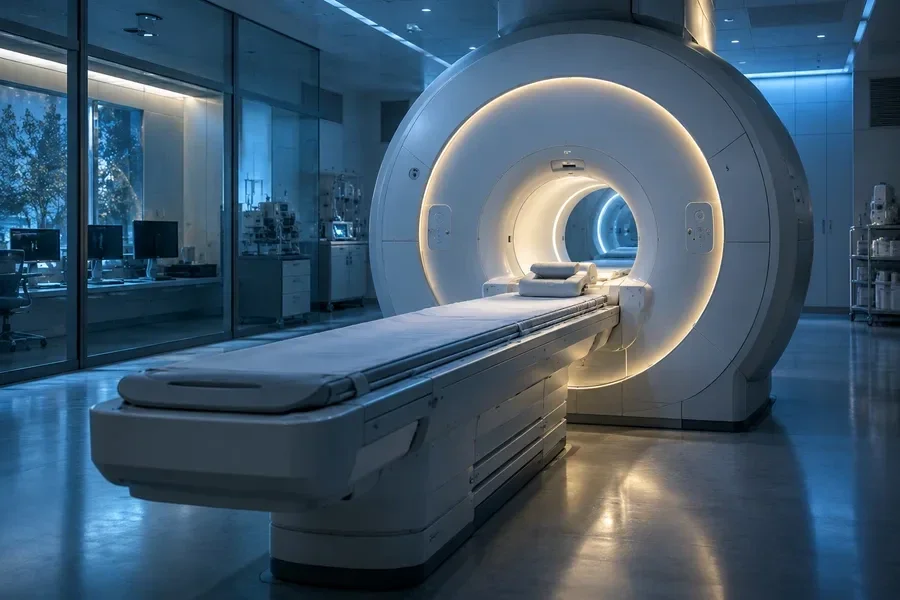
AI reconstruction · Brain tissue and white-matter fibers; not a patient scan or anatomical map.AI reconstruction · An MRI research suite; no actual study participant or scan is shown.
Diffusion M R I measures in community-dwelling older adults in India linked healthier superficial white matter—the short U-shaped fibers beneath the cortex—with stronger language performance. Gray-matter measures remained the strongest overall correlates, while local wiring appeared to modify some associations. Because the study was cross-sectional, it cannot determine which changes came first or prove that protecting these fibers prevents decline.
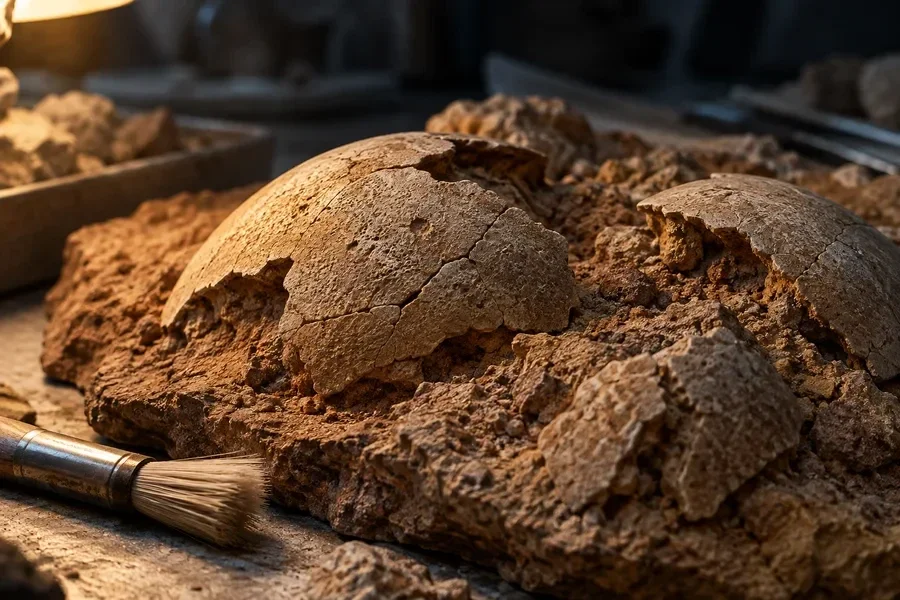
AI reconstruction · A speculative titanosaur nesting landscape; nest details remain uncertain.AI reconstruction · Mineralized eggshell material; not the published fossil specimens.
More than two hundred fifty eggshell fragments from southern Patagonia date to about sixty-eight million years ago. Their microstructure is associated with titanosaurs. The reconstructed eggs held roughly four liters, while the nesting ground lay near fifty-five to sixty degrees south at the time. Shell pores and sediments are consistent with burial, but fragments alone cannot reconstruct a complete nest or prove the exact heat source.
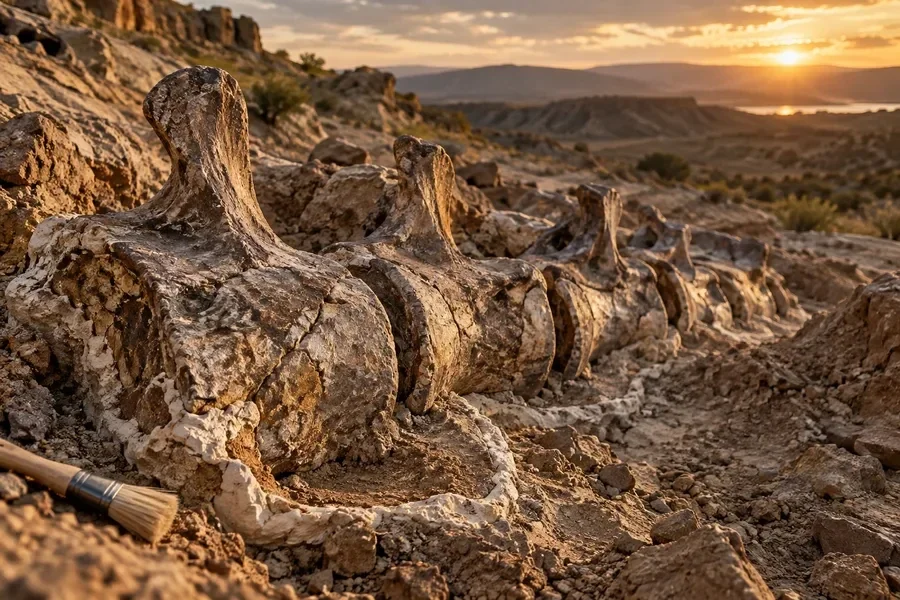
AI reconstruction · Diplodocus in an imagined Jurassic landscape; appearance is reconstructed.AI reconstruction · A sauropod-tail excavation; not the actual Spanish specimen.
Fundación Dinópolis announced that fourteen tail vertebrae and associated chevrons from Teruel represent the first confirmed Diplodocus fossils outside North America. The animal is estimated near twenty-five meters long and about one hundred fifty million years old. Because the Journal of Vertebrate Paleontology paper was reported as in press at the cutoff, this remains a research-watch item pending the final article and its complete methods.
10. An interstellar comet carries a colder chemical memory
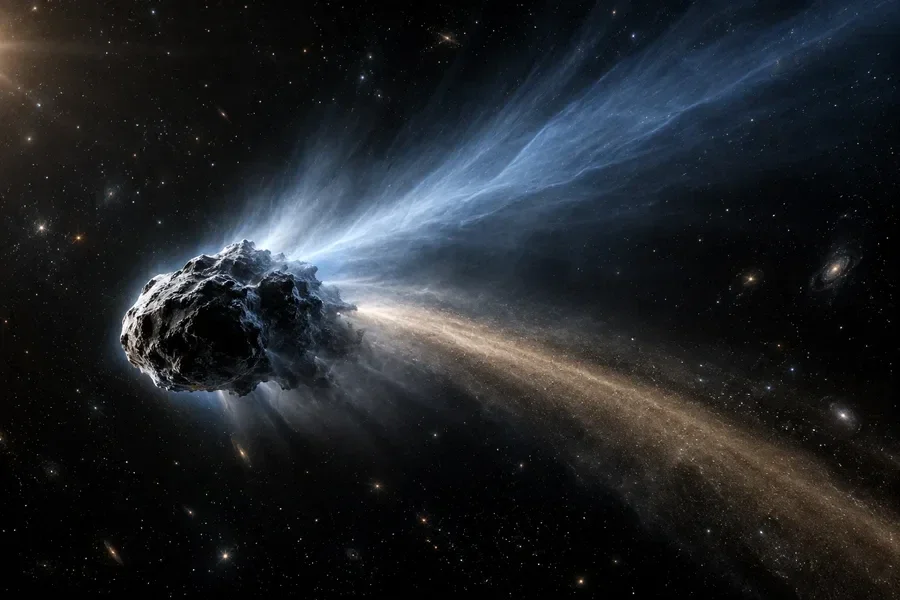
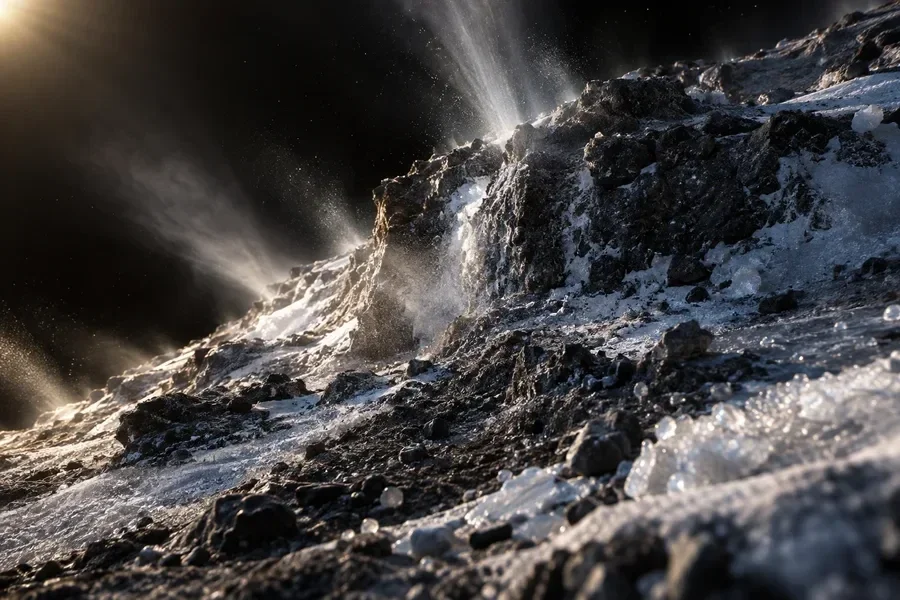
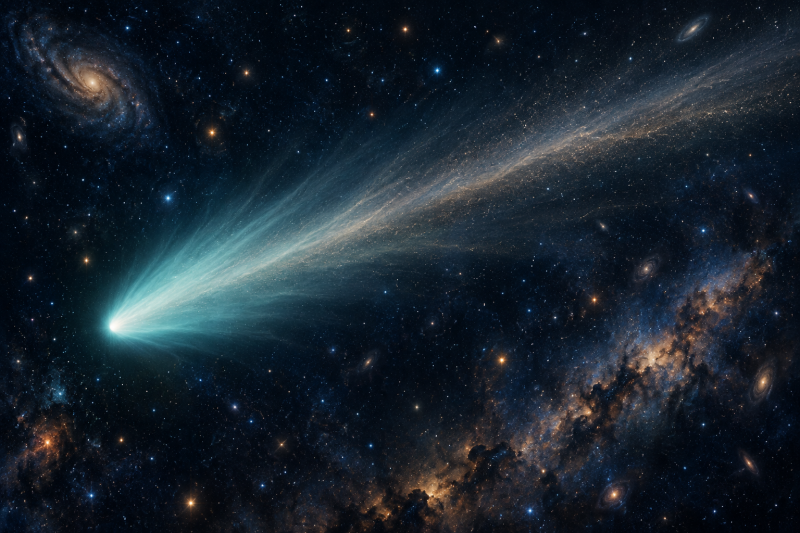
AI reconstruction · An artist’s close view of interstellar comet 3I/ATLAS; not telescope data.AI reconstruction · Imagined comet frost and gas jets; surface geography is unknown.
Spectra of the plasma tail of interstellar comet three I slash ATLAS showed an unusually high abundance of ionized nitrogen relative to ionized carbon monoxide compared with familiar Solar System comets. The authors interpret that ratio as evidence for formation in a very cold region of another planetary system, where nitrogen could be incorporated efficiently. It is a chemical thermometer with model assumptions, not a direct temperature measurement from the comet’s birth.
11. A century-old chemistry shortcut gets a boundary check
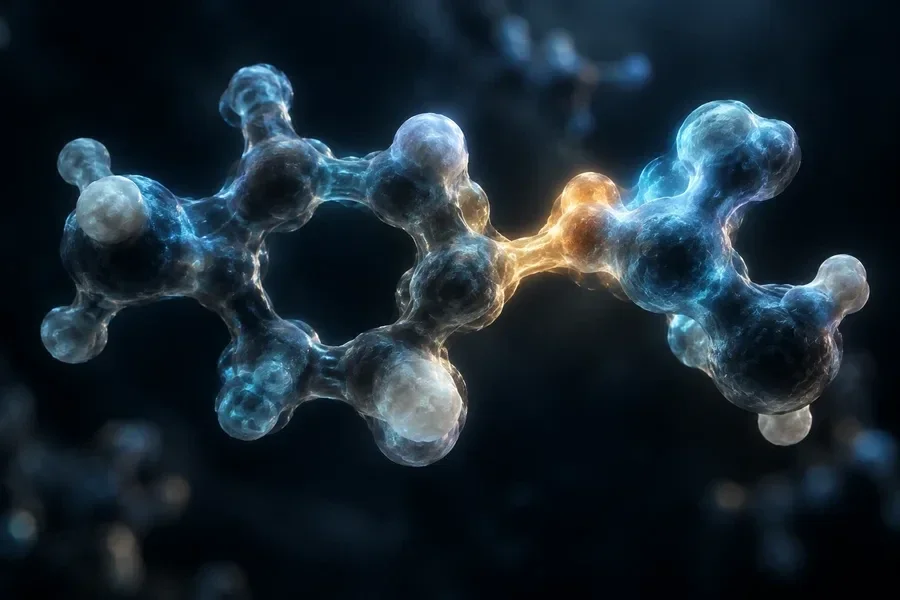
AI reconstruction · An evocative molecular visualization; not calculated electron-density data.AI reconstruction · An analytical chemistry laboratory with sample vials.
A Cardiff-led reassessment argues that the classical inductive effect in neutral organic molecules is effectively limited to one bond, and that farther-away trends often assigned to induction should be treated skeptically or explained by other effects. The work challenges a common teaching shortcut; it does not abolish electrostatic, hyperconjugative or polarizability effects, nor does it make every textbook mechanism wrong.
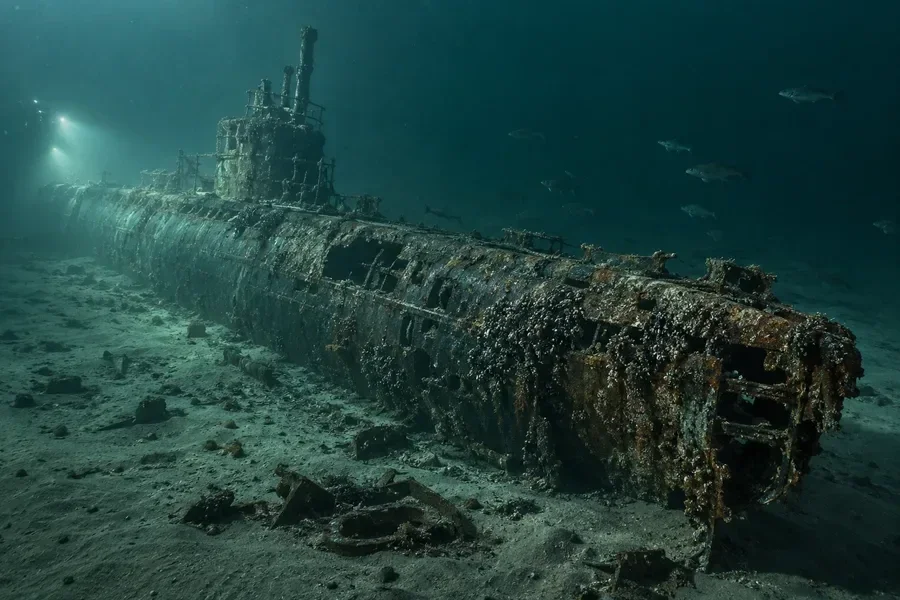
12. A century-old submarine still releases an explosive legacy
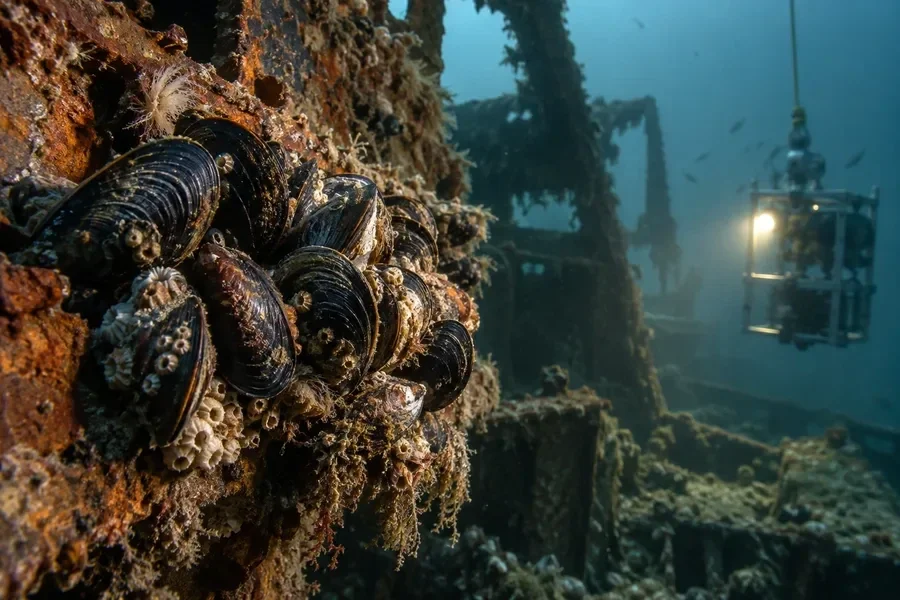
AI reconstruction · A North Sea submarine wreck inspired by UC-30; exact geometry is not reproduced.AI reconstruction · Mussels on corroded steel during an imagined survey; pollutants are not visibly depicted.
Researchers studying North Sea war wrecks found T N T or related contamination in water or sediment near the German submarine U C thirty and measured biological stress in caged mussels. The evidence indicates a localized pollution source that can worsen as metal corrodes and munitions become exposed. The study supports site-specific monitoring; it does not show that every wreck produces the same risk or that contamination is spread uniformly across the sea.
Across all twelve reports, the hidden world leaves a trace. Matter waves preserve a phase. Planetary surfaces preserve strain. Molecules preserve geometry. Fossils preserve geography and behavior. Comet ions preserve formation conditions. Mussels preserve exposure. The discipline is not to turn every trace into a dramatic claim, but to compare explanations and keep uncertainty attached to the conclusion.
Wonder Room field exercise
Open the Gravity Observatory. Run two trials while changing only one variable. Predict the result before pressing start, record what actually happens, and then explain the difference between your prediction and the observation. That three-step loop—predict, measure, update—is the working heart of every story in this magazine.
Today’s clearest takeaway is simple. Nature does not owe us an obvious answer, but it often leaves enough evidence to build and test one. Wonder. Observe. Discover.
AI-generated editorial cover · credits and sources in the full edition.
Welcome to the Omega Science Explorer Almanac. This is the September thirteenth, twenty twenty-six edition. Today's signal: Hidden Structure, Clearer Signals.
Ever looked at something you've passed a hundred times and suddenly noticed a detail that changes the whole picture? Science has days like that, too. A material gets a useful new structure. An old telescope archive gives up a surprise. A faded wall starts telling a story again.
Let's take these discoveries one at a time. You don't need a physics degree. You need a little curiosity, and a willingness to ask, “All right, but how does that work?” That's a perfectly respectable starting point.
White without the paint bucket
Start with snow. A piece of clear ice lets light through. A pile of snow looks white because light gets scattered among all those ice crystals and air pockets. Different arrangement, different appearance.
Researchers have used a related idea in plastic. They treat a light-sensitive polymer, then use a solvent to help form tiny pores. Those internal boundaries scatter light. By controlling the structure, the team can make white and grayscale patterns. Changes in surface texture also produce strongly water-repellent surfaces.
The technical name is deep-foam photolithography. That's a mouthful, so keep the useful picture: light helps write the pattern, and tiny empty spaces help produce the appearance.
Think of light trying to get through a room full of people who keep sending it in another direction. It's getting the family-reunion directions treatment. The actual process is scattering at material boundaries, of course; the light isn't stopping to ask anybody.
Here's the engineering lesson. An empty space isn't automatically a defect. Put it in the right place, at the right scale, and it can do a job.
But a clever sample isn't a finished production line. Cost, durability, processing chemicals, and disposal still need attention. Pigment-free tells us something specific. It doesn't certify the whole process as harmless.
Reading the tracks after a particle collision
Now for the particle collider. Stay with me; we can leave the equations on the bench for a minute.
The ATLAS experiment reports strong evidence of a quantum connection called entanglement between the spins of paired Z bosons. These are short-lived particles, so researchers don't just point a camera at them and watch. They study the directions of particles left by the decays.
Imagine investigating a machine failure by looking at where the pieces landed. Those directions can tell you something about what happened before. That's the role of the analogy here: understanding why the aftermath contains information.
The quantum part goes beyond ordinary machine parts. Entanglement means the joint system cannot be fully described as two independent quantum states. Researchers test whether the observed patterns fit an entangled system better than a separable one.
The strongest test favors the entangled explanation, with an important condition: it uses assumptions from the Standard Model, our established particle-physics framework. This isn't a report that physics has fallen apart. It's a demanding check of how well the framework holds together.
The paper reached its journal-publication milestone this week. The result itself had already been shared earlier. A new publication date doesn't mean the experiment happened yesterday.
An inspection assistant for the Moon
From tiny particles, let's head to a very large inspection job: mapping the Moon.
NASA and IBM released an artificial-intelligence model trained on roughly two million lunar image tiles. It can be adapted to tasks such as mapping craters and estimating where polar ice could remain stable.
Picture handing an inspector a warehouse full of photographs. Even a very good inspector needs help sorting that mountain. A trained model can help find patterns and narrow the search. Researchers still have to check what those patterns mean.
Here's the distinction that matters. Finding conditions where ice could survive is like finding a shady spot where an ice chest might stay cold. It doesn't prove somebody left an ice chest there.
The model is a tool for investigation. An estimated favorable location is not a measured ice deposit. Lighting can also change what a crater looks like, so good benchmark results don't make the tool right in every circumstance.
The telescope archive with another story to tell
Sometimes the next discovery is waiting in measurements we already have.
Researchers searching Chandra's archive identified eighty-four unusual X-ray sources across six galaxies. They stand out at the lower-energy end of the X-ray range and fade from higher-energy views.
Think of listening to a recording with one range of sound turned down. You might miss something that becomes obvious when you listen differently. Here we're talking about X-ray energies, not sound, but the lesson carries over: what your instrument lets through shapes what you notice.
Some sources might involve compact objects drawing material from companion stars. That's a possible explanation, not a settled identity for the whole group.
And that's a worthwhile discovery in its own right. Sometimes progress means finding a better question before you find the answer. “We don't know what all these are yet” can be the beginning of serious work, not a failure of it.
A glacier forecast is not an appointment
Back on Earth, a newly launched glacier explorer lets people compare projections for individual glaciers under different warming scenarios.
Big global averages are hard to picture. A valley you recognize gives the question a place to stand.
Think about estimating how long a bank balance lasts. Your answer changes with what comes in, what goes out, and the assumptions you make. A glacier has a physical balance involving accumulation and loss. The analogy helps explain why different conditions produce different futures; the actual ice models are much more involved.
So a projected disappearance date is not an appointment written into nature's calendar. It is an answer to a conditional question: under this scenario, what does the model project?
That doesn't make the result useless. It tells us how to use it honestly. Compare scenarios. Look at the assumptions. Don't turn a forecast into a countdown clock with false precision.
Bringing faded artwork into view
Our last main story starts with a familiar frustration: an old picture where you can barely make out the details.
NASA's new retrospective explains how a technique for enhancing satellite images found another use in archaeology. Through software called DStretch, subtle color differences can be made easier to see, helping faded pigments stand out.
Think of separating several nearly identical threads so you can follow each one. The processing strengthens contrasts already present in the image. It doesn't give the computer permission to invent the picture you hoped to find.
And making a mark visible doesn't establish who made it, when, or what it meant. Those questions need other evidence.
The Angkor Wat paintings discussed in the feature were discovered between twenty ten and twenty twelve. The feature is new; those discoveries are older. Keeping that straight is part of respecting the work—and the reader.
Three things to keep on the workbench
Before we go, three earlier September developments deserve a careful follow-up.
First, a study found longer median lifespan in semaglutide-treated female mice than in controls. The reported medians were eight hundred thirty-four days and seven hundred forty-two days. Those are study results in female mice, not a promise about human life.
Separate comparisons with calorie restriction give researchers reasons to investigate effects beyond eating less. They don't justify starting or changing medication to chase longevity. Hope deserves better than a shortcut past the evidence.
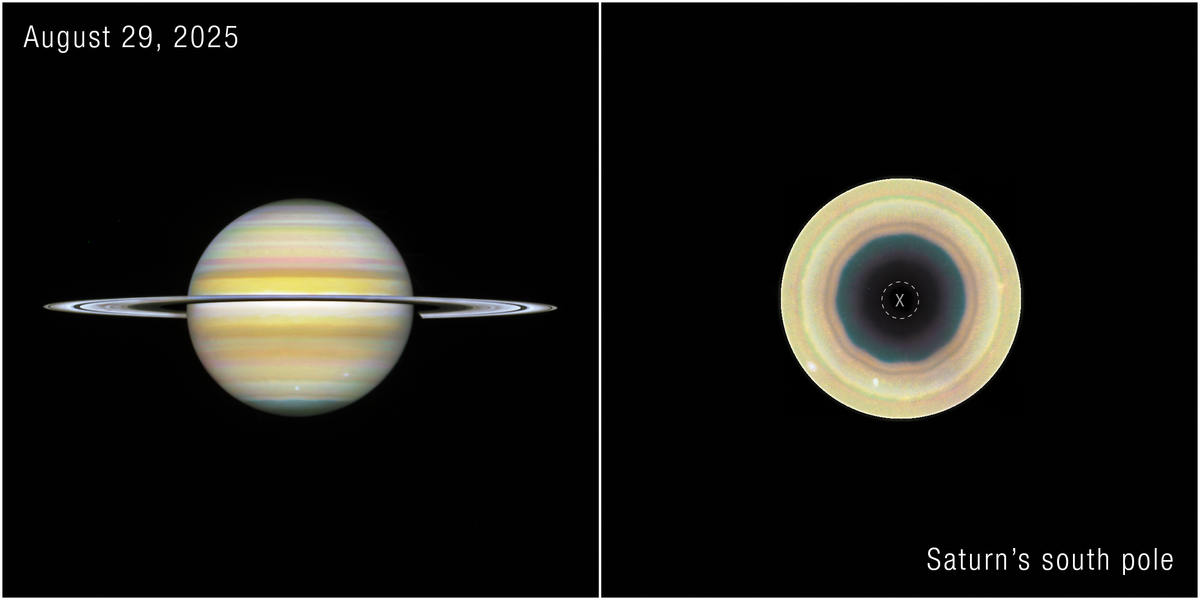
Second, Hubble observations show an evolving ten-sided atmospheric wave around Saturn's southern polar region. There's no fence or solid decagon up there. It's a pattern in an atmosphere. How it formed and how long it will persist remain questions. Nature has supplied the pattern; scientists still have to work out the explanation.
Third, Anthropic reported a machine-checked formalization of Fermat's Last Theorem. Think of the distinction between having an engineering argument and translating every necessary step into a form a checker can verify. That comparison captures the checking job, not the mathematics itself.
The announcement concerns formalizing an existing result, not discovering the theorem for the first time. We haven't independently rebuilt that proof for this edition, so we're identifying it as the company's report.
Take a closer look
What's the thread through all of this? Better ways to look, and better habits for deciding what we're looking at.
A pore can help shape a material's appearance. A decay pattern can test a quantum relationship. An enhanced photograph can reveal a trace of human expression. None needs an exaggerated headline to be worth your attention.
If you'd like a small job of your own, the linked NASA introduction to Artifact InSPECtor explains how volunteers can help identify unwanted signals in telescope data. Start with the tutorial. Learning to recognize what doesn't belong is part of learning what to trust.
The research notes below carry the sources, dates, and limits behind this story. Keep your curiosity. Bring your questions. And don't be embarrassed to ask for the plain-English version.
Wonder. Observe. Discover.
OMEGA SCIENCE NEWS
Daily Science Signal · Sunday, September 13, 2026
Hidden Structure, Clearer Signals
White without pigment. Quantum correlations. New ways to read the Moon—and the future of ice.
News window: September 6–13, 2026 · America/Indiana/Indianapolis · EDT, UTC−4. Selected earlier research appears separately in the Almanac Follow-ups, with original dates.
Opening Signal
What can you do with a better look? Sometimes you can give a material a new job. Sometimes you can find a pattern hidden in years of measurements. And sometimes you discover that the most interesting question is still unanswered.
This Sunday’s journey runs from a white polymer foam to the machinery of particle physics, then outward to the Moon and distant galaxies before returning to Earth’s glaciers and traces of ancient art. The connecting thread is practical curiosity: look carefully, explain the mechanism, and distinguish a promising result from a finished answer.
[T] Source-supported · [I] Editorial inference · [H] Hypothesis or proposed application · [U] Unresolved. A source-supported claim remains open to revision.
The News Brief
Materials: [T] A patterned polymer foam creates structural whiteness and water-repellent surfaces. Explore the material.
Quantum physics: [T] ATLAS reports strong evidence for entanglement between Z-boson spins. Read the evidence.
AI and space: [T] A released lunar model helps analyze surface features; Chandra’s archive reveals unusual X-ray sources. Look closer.
Earth: [T] An interactive glacier map makes warming scenarios local. Explore the projections.
Archaeology: [T] A new feature revisits how image enhancement reveals faded artwork. Follow the technique.
Direct sources and evidence limits accompany each story below.
The Big Discoveries
01 · Materials & Engineering
Making white by building the right empty spaces
Peer-reviewed laboratory research · Nature · September 9, 2026
What happened. [T] Researchers developed deep-foam photolithography: a way to pattern polymers into porous structures that produce white and grayscale images, along with surfaces that strongly repel water. Qin and colleagues, Nature.
How it works. [T] Light modifies a photosensitized polymer; a weak solvent then drives pore formation and expansion. Controlled collapse changes the surface texture. The work demonstrates patterning in films and fibers, with resolution around 20,000 dots per inch.
Why it matters. [I] An empty space can be a functional part of a material. Instead of treating pores as defects, engineers can use them to control appearance and wetting. That suggests useful design possibilities for printing and fluid handling.
The boundary. [U] These results do not establish lower lifetime environmental impact or lower manufacturing cost than existing products. Durability, processing requirements, and end-of-life behavior still matter. “Pigment-free” is a specific achievement, not proof that the entire manufacturing process is harmless.
02 · Particle Physics
A quantum relationship survives the violence of a collider
Peer-reviewed publication milestone · Physical Review Letters · September 11, 2026; preprint March 27
What happened. [T] ATLAS reports strong evidence of entanglement between the spins of Z-boson pairs associated with Higgs decays. Its most sensitive test disfavors a separable-state explanation at 4.7 standard deviations relative to the entangled Standard Model hypothesis. Published paper and metadata.
How it works. [T] Researchers analyze the directions of the resulting charged leptons—particles that carry information about the decay. Their angular distributions allow tests of the parent system’s quantum correlations. ATLAS abstract and preprint.
Why it matters. [I] This extends the experimental reach of entanglement studies into massive vector bosons. The interest is in checking quantum behavior under demanding conditions.
The boundary. [T] The highest-sensitivity test relies on Standard Model assumptions about the decays. [U] It is not evidence of physics beyond that model. This week’s milestone is journal publication; the result was already publicly available.
03 · AI & Planetary Science
A lunar image archive gets a new set of tools
Open model and dataset announcement · NASA · September 10, 2026
What happened. [T] NASA and IBM released a lunar foundation model trained on roughly two million image tiles, supporting tasks such as crater mapping and estimating polar ice stability. NASA’s release.
How it works. [T] Broad pre-training provides a starting point that can be adapted to particular mapping tasks. NASA reports that the model matched or exceeded its tested baselines across evaluated tasks, with a clear advantage on ice-stability estimation.
Why it matters. [I] Think of an assistant sorting an enormous inspection archive. It can help surface relevant patterns, giving researchers more time to ask what those patterns mean.
The boundary. [U] Estimating conditions where ice could survive does not demonstrate an actual ice deposit. Lighting changes can affect crater visibility, and benchmark performance is not a universal reliability guarantee.
NASA links public code, model files, benchmarks, and a companion paper. The release is verified; peer-review status of that companion paper is not established here.
04 · Astronomy
The objects that show up when you lower the energy
Archival observational study · NASA report September 9, updated September 11, 2026
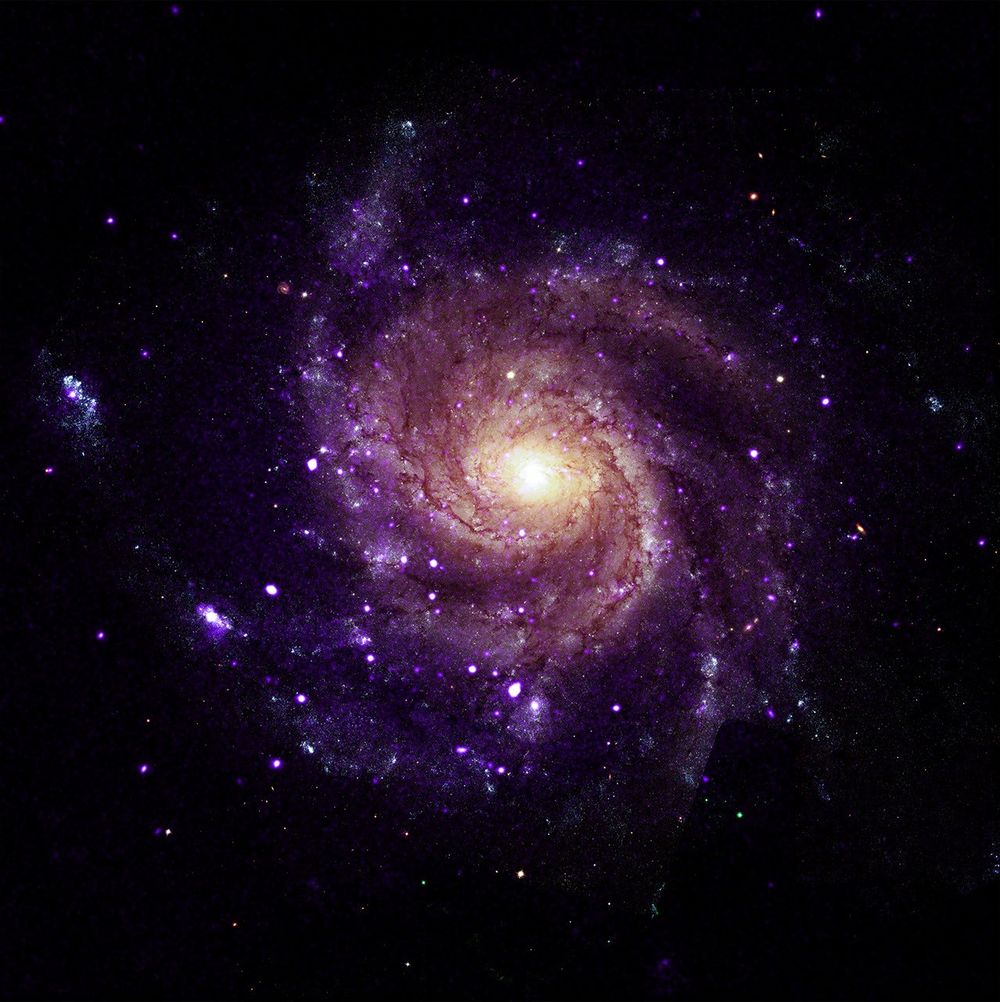
M101: a processed X-ray and optical composite, not an illustration. X-ray: NASA/CXC/Univ. of Alabama/M. Muhibullah et al.; optical: NASA/ESA/STScI; processing: NASA/CXC/SAO/N. Wolk.
What happened. [T] Researchers found 84 hypersoft X-ray sources in six galaxies using Chandra’s archive. NASA’s account.
How it works. [T] The sources appear in low-energy X-ray images and fade from higher-energy views. Their spectra imply substantial ultraviolet emission.
Why it matters. [H] Some may be compact objects drawing material from companions, potentially offering clues about systems that precede Type Ia supernovae.
The boundary. [U] Their physical identities remain uncertain. A distinctive observational category does not yet settle the mechanism. NASA reports the study’s publication in Nature Astronomy; this edition relies on its institutional summary.
05 · Earth & Climate
Put a place you know on the glacier map
Public visualization launch · VUB · September 11, 2026
What happened. [T] The Global Glacier Extinction Explorer translates published research into projections for individual glaciers under different levels of warming. VUB announcement.
How it works. [T] Users compare whether, and approximately when, a glacier is projected to disappear as the warming scenario changes. The platform builds on a Nature Climate Change study.
Why it matters. [I] An average for the entire planet can be hard to grasp. A familiar valley gives the question a location, making assumptions and consequences easier to discuss.
The boundary. [U] A model’s disappearance date is conditional, not an appointment. VUB also says final Alpine end-of-summer measurements are still underway; preliminary concerns about 2026 are not a completed annual ranking.
The new development is the public tool. The underlying modeling predates its launch.
06 · Archaeology & Imaging
When a space-imaging method finds a second life in archaeology
New retrospective feature · NASA · September 8, 2026
What happened. [T] NASA revisits how decorrelation stretch moved from remote-sensing imagery into archaeological work through Jon Harman’s DStretch software. NASA’s feature.
How it works. [T] The technique enhances color contrasts, helping faded pigments stand out. The feature includes original and processed views of rock art.
Why it matters. [I] Useful engineering ideas can travel. A method developed to distinguish surface features can also help examine traces of human expression.
The boundary. [U] Enhancement does not independently establish age, authorship, or meaning. [T] The Angkor Wat paintings discussed were discovered in 2010–2012. September 8 is the feature’s publication date, not the date those paintings were found.
Almanac Follow-ups
Earlier September research worth understanding. These items fall outside the seven-day news window.
A longevity result—with “female mice” kept in the headline
[T] A Nature paper published September 2 reports median lifespans of 834 days in semaglutide-treated female mice and 742 days in controls. Treatment began at 20 months of age. Separate comparisons with matched calorie restriction found overlapping benefits and some differences in memory, exploratory behavior, and glucose control. Feng and colleagues, Nature.
[H] Those differences motivate investigation of effects beyond reduced food intake. [U] They do not establish longer human lifespan. This animal result is not a reason to start or change medication for longevity.
Saturn’s ten-sided wave is real; its future is unknown
[T] NASA’s September 2 report describes an evolving southern atmospheric decagon, supported by Hubble observations extending back to 2023. [U] How it formed and how long it will last remain questions for observations and modeling. NASA/Hubble report.
Hubble observations from August 29, 2025, presented with a south-polar projection. The central X marks missing data. NASA, ESA, STScI, A. Sánchez-Lavega (UPV), A. Simon (NASA-GSFC), M. Wong (UC Berkeley); processing: A. Pagan.
Fermat: a milestone in checking mathematics
[T] On September 4, Anthropic reported a complete Lean formalization of Fermat’s Last Theorem, produced largely autonomously by Claude over 11 days. [I] The important distinction is formal verification of an existing mathematical result, rather than a new discovery of the theorem. [U] The released proof has not been independently rebuilt for this edition. Anthropic’s account and artifact links.
The Almanac Lens
[I] The useful connection is not a hidden law tying every story together. It is a way of working: separate the object from the instrument, the measurement from the model, and the model from its possible applications.
A promising foam still needs a manufacturing assessment. A glacier projection still depends on a scenario. A mathematical argument still needs a checker. The wonder survives those distinctions. In fact, it becomes more interesting when we can say exactly what changed—and what question to ask next.
One Thing to Explore
Try the introductory tutorial for Artifact InSPECtor. [T] NASA’s September 11 announcement invites volunteers to help identify unwanted signals in telescope data. It describes using Euclid data now and Roman data beginning in early 2027. Start with NASA’s project introduction. The question is a good one for any curious reader: what makes a signal worth trusting?
Sources & Transparency
AI-assisted reporting. Sources and uncertainties are identified for reader review.
Primary papers, publisher records, and institutional reports are linked beside the claims they support. The Nature materials paper’s accessible abstract and supporting page were reviewed; its subscription-only main text was not. ATLAS publication metadata and abstracts were checked. Institutional summaries support the lunar, X-ray, glacier, and archaeology reports. No independent experiment, clinical review, or Lean proof rebuild is claimed.
Watch Donsol on our existing WTFacts YouTube channel. Pull up a chair for strange discoveries, practical explanations, and the occasional “Well, how in the world does that work?”
Watch on WTFacts. Explore the stories, sources, and Discovery Lab here. One home for curiosity, whether you would rather watch, read, or listen.
Featured Short · 30 seconds · Creative reflection
A Universe on Your Window
A branching frost crystal becomes a way to imagine extraordinary patterns emerging from simple rules. Join DonSol for a little wonder at the window.
Frost is a metaphor here, not an explanation of the Big Bang.
I’m Donald Wilson—also known as Donsol. Roughly 25 years in machining and tool-and-die work taught me to turn ideas into parts, listen to a machine, and check the result.
From Rolls-Royce and Gasoline Alley to the engineering of the SR-71 and single-crystal turbine blades, I’m drawn to what happens when imagination meets precision.
A useful tool still needs someone checking the work.
AI helps with research discovery, drafting, illustrations, coding, and narration. A useful answer still needs evidence. Donald Wilson is responsible for Omega’s editorial choices and for addressing mistakes.
Books & Essays · Original work by Donald Wilson / Don Sol
The Arc, in pictures and words.
Life. Mind. Tools. Responsibility. Open the complete manuscripts with 55 scene illustrations. Pictures appear beside the chapters; Listen opens the synchronized slideshow. This literary collection includes philosophy, interpretation, and metaphor, separate from our science reporting.
If you leave with a better question or a new understanding, you can help support the next story and learning activity. Every contribution is voluntary.
The clearest discovery signal this window is not a new planet. It is a census of the wreckage left when rocky worlds collide. On 1 October, ESA and the Space Telescope Science Institute reported that a team led by Kate Su of the Space Science Institute used the James Webb Space Telescope, with archival Spitzer data, to assemble 21 extreme debris discs. The paper is in The Astrophysical Journal.
These systems hold unusually large amounts of warm dust in the zone where rocky planets orbit. Mid-infrared spectra show smaller grains than ordinary debris discs, high warm-dust concentration, and irregular brightness. About one third of the sample is silica-rich. The team reads silica-rich discs as vaporizing, high-energy impacts between roughly Mars-sized bodies, and only around stars younger than about 300 million years. The other two thirds are silica-poor, consistent with smaller, often grazing collisions that can persist and flicker.
Observable extreme debris discs appear rare: roughly 1 percent of young stars in the data so far. That rarity, plus the age split, is the useful result. Moon-forming violence may be a short, uncommon phase, not the default setting of every planetary system.
Colliding Worldsâ¾
Webb maps the mineral signature of planet-shattering collisions.
WHAT HAPPENED: Su and colleagues compiled 12 newly observed extreme debris discs plus follow-up and archival targets, 21 systems in total. Spectra sort them into silica-rich and silica-poor.
WHY IT MATTERS: Planetary embryos are too small to image directly. Their collision debris is now a measurable proxy for impact energy and composition.
WHAT IT COULD BECOME: A clock for the rocky-planet assembly phase, and a test of whether our own Late Heavy Bombardment left a silica-poor infrared flicker.
WHAT IT MEANS FOR YOU: The Moon-forming impact stops being a unique story and becomes a class of events with a measurable rate.
Roman First Lightâ¾
Roman's coronagraph took its first focused image in space. It is not a planet picture.
WHAT HAPPENED: NASA JPL reported on 30 September that the Coronagraph Instrument on the Nancy Grace Roman Space Telescope opened to cosmic light on 22 September and produced a focused test image after focus adjustment. The instrument powered on 1 September.
WHY IT MATTERS: This is the technology path for blocking starlight so faint planets and disks can be seen.
WHAT IT COULD BECOME: A methodical commissioning sequence toward a dark hole on the sky. NASA expects Roman's first public images in early 2027.
WHAT IT MEANS FOR YOU: Direct images of nearby worlds depend on this hardware working, not on another press render.
Earth's Shieldâ¾
SMILE has started science. The X-ray smile of Earth's magnetic shield is still ahead.
WHAT HAPPENED: ESA said on 30 September that the European-Chinese SMILE mission was declared ready for science on 23 September. The ultraviolet imager released the first full-ring northern-aurora footage since 2008, recorded 24 July, and can now record the ring for about 45 hours at a time. The soft X-ray imager is on and has calibration images of a distant supernova remnant. A clean X-ray image of the magnetopause or northern cusp is not in hand. ESA expects stray earthshine to fall enough by mid-October.
WHY IT MATTERS: Auroras and power-grid risk are the ground footprint of solar wind hitting the magnetosphere.
WHAT IT COULD BECOME: An operational view of the boundary the mission was named for. The UK Met Office Space Weather Operations Centre is already working with the team.
WHAT IT MEANS FOR YOU: Better space-weather timing is an infrastructure problem, not only a sky show.
X-Ray Flashâ¾
Einstein Probe caught a new X-ray transient on 3 October.
WHAT HAPPENED: GCN Circular 45798 from the Einstein Probe team at NAOC reports EP261003a, triggered by the Wide-field X-ray Telescope at 00:14:43 UTC on 3 October. Position: right ascension 307.524 degrees, declination minus 12.936 degrees, about 3 arcminutes uncertainty. A follow-up telescope found an uncatalogued source inside that circle, uncertainty about 20 arcseconds. Telemetry was still incoming.
WHY IT MATTERS: Wide-field X-ray monitors are how short-lived mergers, flares, and magnetar-like events get caught before they fade.
WHAT IT COULD BECOME: A classified counterpart once optical, radio, or gamma data arrive. Source class is unknown.
WHAT IT MEANS FOR YOU: Most violent cosmic events are found by machines that never sleep, then handed to telescopes that can point.
Moon Ironâ¾
Chang'e-6 soil holds a lunar iron phase not previously seen in natural Moon samples.
WHAT HAPPENED: A Chinese Academy of Sciences team led by Haifeng Du reported in PNAS on 16 September, widely circulated again on 3 October, that face-centered cubic gamma-iron dominates metallic iron particles inside two impact-glass grains from Chang'e-6 far-side soil. In 50 examined particles, gamma-iron was 64 percent of one sample and 76 percent of the other. A basalt grain was ordinary alpha-iron. Larger gamma-iron particles held a stable single-vortex magnetic state.
WHY IT MATTERS: Gamma-iron is normally a high-temperature phase. Impact glass appears to have quenched it. It may be an extra recorder of ancient lunar magnetism.
WHAT IT COULD BECOME: A new mineral clock for the Moon's disputed dynamo.
WHAT IT MEANS FOR YOU: Returned dirt is still doing work that orbiters cannot. The magnetic-fossil claim is a hypothesis until more grains are measured.
Brain Circuitsâ¾
One depression diagnosis can hide opposite brain-connectivity patterns.
WHAT HAPPENED: University of Helsinki researchers, release 23 September and reported 4 October, used magnetoencephalography on 263 people with major depressive disorder and 75 controls. They found five functional-connectivity groups, from broadly strong coupling with severe symptoms to weak coupling with milder symptoms, a trauma-linked low-connectivity group, a mixed group, and a strongest-connectivity group marked by substance use.
WHY IT MATTERS: Conflicting depression imaging studies may have been averaging unlike brains.
WHAT IT COULD BECOME: A stratification tool, not a treatment. Personalized psychiatry follows only if the groups replicate and predict outcome.
WHAT IT MEANS FOR YOU: The same label does not mean the same circuit.
Quantum Grapheneâ¾
The physics paper inside this window is materials, not a new particle. Nature, 1 October 2026, carries work by Anna Okounkova, Abigail Sohm, and colleagues on anomalous metal and superconducting phases in rhombohedral graphene.
The claim, as reported from the journal issue, is that ultra-clean, tunable rhombohedral graphene shows an anomalous metal alongside superconductivity, and that reproducibility argues against a simple dirt explanation. If the phase is intrinsic, stacked graphene becomes a controllable bench for the strange metal problem that also shows up in high-temperature superconductors.
This desk has not independently read the full methods. No promotion above a journal-indexed result. No quantum-gravity or room-temperature claim is supported.
Fragmented Forestâ¾
Forest fragmentation changes local temperature, not only carbon totals.
A satellite analysis reported 4 October found that, in tropical and temperate zones, breaking continuous forest into isolated patches raised surface temperature by an amount comparable to the effect of losing forest area. In high-latitude boreal forest the same breakup cooled the surface, because open ground exposed more reflective snow.
Climate accounting that tracks only hectares will mis-state the energy budget.
Moon's Birthâ¾
If you remember one thing: rocky planets announce their violent youth as warm dust, and Webb can now read the mineral dialect of those collisions. About one percent of young stars show it. Silica-rich wreckage looks confined to the first 300 million years.
The Moon-forming impact fits that window. It is evidence of a phase, not a portrait of Theia.
THE PAPER OF THE DAY
Kate Su and colleagues, The Astrophysical Journal, released with ESA/Webb on 1 October 2026. DOI: 10.3847/1538-4357/ae88fe.
Question: what are extreme debris discs, and what collisions make them? Method: mid-infrared spectra from Webb and Spitzer on 21 systems, then mineral sorting. Result: three shared traits â small grains, warm dust, irregular brightness â and a silica split. About one third silica-rich, only under 300 million years, read as Mars-scale vaporizing impacts. Two thirds silica-poor, broader ages, more variability, read as smaller or grazing impacts. Evidence: spectra and sample statistics, not resolved images of the colliding bodies. Limitations: the older silica-poor age bin rests on three discs. The authors say more systems are needed. The Late Heavy Bombardment link is consistency, not a proof. Why it matters: it turns an unseen phase of rocky-planet growth into a compositional measurement.
WHY THIS MATTERS TO YOU
Three threads touch ordinary systems. SMILE is aimed at the solar-wind boundary that drives auroras and can disturb satellites and grids. Roman's coronagraph is the hardware bet behind any future picture of a nearby pale dot. The depression subtypes are a warning against one-scan medicine: opposite connectivity can share a diagnosis, so a single biomarker headline is premature. The Webb disc result does not change a device in your house. It changes the prior on how often Earth-like assembly includes a Moon-making impact. Forest fragmentation is the local item: patch size is a temperature variable, not only a wildlife variable.
REALITY CHECK
WHAT WE KNOW: Webb and Spitzer spectra exist for 21 extreme debris discs. Roman's coronagraph made a focused test image on 22 September. SMILE is in science operations and has ultraviolet auroral-ring footage plus X-ray calibration frames. Einstein Probe triggered on EP261003a. Chang'e-6 impact glass contains gamma-iron. A 263-patient MEG study found five connectivity groups.
WHAT WE THINK: Silica tracks impact energy and body size. Gamma-iron may store lunar magnetic history. Depression groups may explain contradictory imaging.
WHAT WE DON'T KNOW YET: Whether Roman can dig a dark hole deep enough for planets. Whether SMILE will get a clean magnetopause image in mid-October. What EP261003a is. Whether the silica-poor and Late Heavy Bombardment link survives a larger sample. Whether depression subtypes replicate or predict treatment.
CLOSING SIGNAL
If you remember one thing: rocky planets announce their violent youth as warm dust, and Webb can now read the mineral dialect of those collisions. About one percent of young stars show it. Silica-rich wreckage looks confined to the first 300 million years. The Moon-forming impact fits that window. It is evidence of a phase, not a portrait of Theia.
Omega Science News Desk · omegasciencenewsdesk.com · End Transmission
OMEGA SCIENCE NEWS
FOLLOW YOUR CURIOSITY
EVOLVED
nature's most extraordinary survivors â tap to watch











 The Arc · Series Preface
 The Longing
 The Operator
 The Reach
 The Ledger