



DAILY SCIENCE SIGNAL · SEPTEMBER 10, 2026
A universe worth a closer look
This almanac selection explores an interstellar visitor, a cosmology debate, and research closer to home. It brings together work from different publication dates, listed with each story.
Evidence key: T = directly supported observation, publication or announcement; I = interpretation or association; H = contested hypothesis; U = not verified for this edition. A published paper can still contain uncertainty.
01 / SPACE · T: OBSERVATIONS · I: ORIGIN
The visitor carrying another star’s history
A comet is more than ice with a tail. Its chemistry can preserve clues about the place where it formed. For the interstellar object 3I/ATLAS, astronomers have used those clues to look beyond our own Solar System.
In a July 6 report, ESO described measurements from the Very Large Telescope’s UVES instrument. Carbon and nitrogen isotope ratios in the comet’s cyanogen molecules point toward formation around an old, metal-poor star. The findings suggest that the object may be older than the Sun.
That is an extraordinary possibility: a fragment of another planetary system crossing our neighborhood, carrying a chemical record we could never collect by sending a spacecraft to its birthplace.
The limit: Isotope ratios constrain origin through models. They do not identify an exact home star or stamp a precise birthday on the ice. “Ancient visitor” is defensible; a perfectly known birthplace is not.
Primary source: ESO: Older than the Sun, July 6, 2026; Nature Astronomy paper.
02 / COSMOLOGY · H: CONTESTED INTERPRETATION
Is the cosmic speedometer fooling us?

Type Ia supernovae help astronomers measure cosmic distances. But their usefulness depends on understanding how their brightness changes with their environments. Could the ages of their host stars distort the story we read from them?
A new dissenting analysis raises that question in the debate over accelerating expansion. A separate research team argues that modern supernova analyses already account for the relevant effects and that acceleration remains robust. Its paper, “Still Accelerating,” has been available as a preprint since January.
The disagreement is about measurement corrections and statistical interpretation. It is not a new observation of the universe suddenly hitting the brakes, and one disputed analysis does not erase the wider evidence behind the standard cosmological picture.
Try the question: If two lamps look equally faint, are they equally distant—or was one dimmer to begin with? Cosmologists need a much more sophisticated version of that check before turning brightness into a history of the universe.
Research: MNRAS dissenting analysis; Still Accelerating: Type Ia supernova cosmology is robust to host galaxy age evolution. The latter is a preprint source; this edition does not resolve the dispute.
03 / MEDICINE · I: OBSERVATIONAL ASSOCIATION
A psychiatric signal hiding in health records

A Swedish registry study followed 14,694 people with bipolar disorder who used antidiabetic medicines. During periods of semaglutide use, psychiatric hospitalization risk was 21% lower than during comparison periods without a GLP-1 drug. Hospitalization for bipolar relapse was 17% lower.
The analysis compared treatment periods within individuals, which helps address some differences between patients. It cannot remove every source of confounding: treatment timing, other care, and changing health circumstances can still influence outcomes.
The finding deserves a controlled trial. It does not establish that semaglutide treats bipolar disorder, and the lack of a statistically significant signal for other drugs in the study does not prove they have no effect.
What this means: Health records can reveal useful questions for the next experiment. They cannot, by themselves, supply its answer. This is research reporting, not a reason to change medication.
Primary paper: Taipale and colleagues, Acta Psychiatrica Scandinavica, first published June 21, 2026. These are relative associations, not percentage-point reductions.
04 / MOLECULAR BIOLOGY · RESEARCH WATCH
Can a designed DNA strand turn down a cholesterol target?
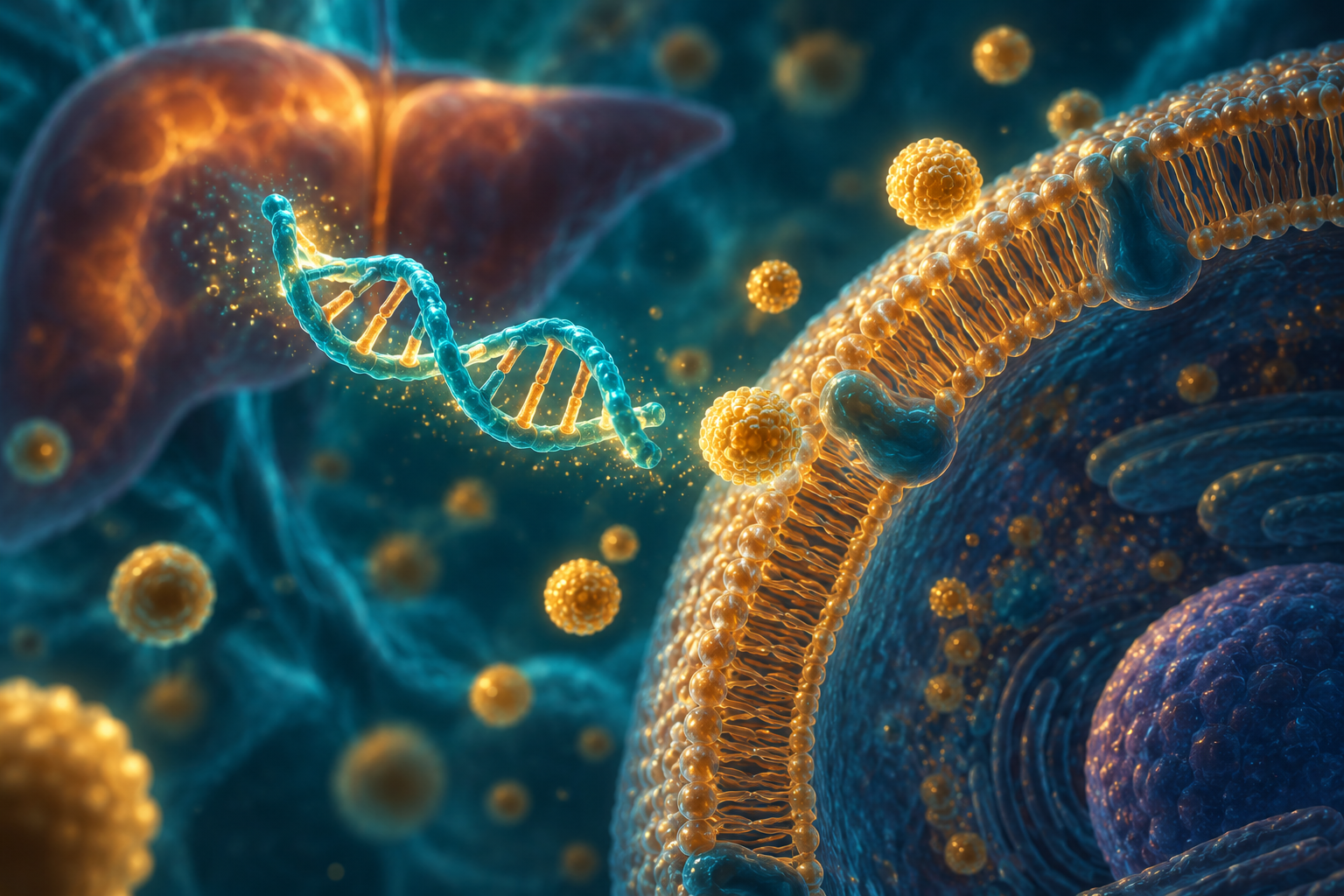
This research revisit looks at a 2025 paper in Biochemical Pharmacology: “Inhibition of PCSK9 with polypurine reverse Hoogsteen hairpins: A novel gene therapy approach.”
The idea is to investigate designed nucleic-acid structures as a way to inhibit a cholesterol-related target. That makes an interesting question for molecular biology: how precisely can an engineered sequence influence gene activity?
Source note: The research record is confirmed, but the full experimental text was not checked for this edition. Treatment effects, duration, and safety are therefore not assessed here.
Keep this one on the watchlist. Before a fuller treatment story, the next checks are the experimental models, dose, duration, safety measurements, and whether any results extend to humans.
Primary research record: López-Aguilar and colleagues, Biochemical Pharmacology 238 (2025), 116976.
05 / EARTH SCIENCE · T: PREPAREDNESS PROGRAMME
A beautiful coast still needs a plan

A calm surface is a moment, not a guarantee. Tsunami preparedness belongs on the Mediterranean coast as well as around the Pacific.
UNESCO’s Intergovernmental Oceanographic Commission coordinates regional warning cooperation and promotes education, exercises, and community readiness. Its official programme lists the Nice Côte d’Azur metropolitan area’s Tsunami Ready recognition in June 2026.
The useful story is what readiness means in practice: communities need to understand the hazard and know where official information and local evacuation plans come from. Recognition is evidence of preparedness work, not a promise that a coastline is risk-free.
The limit: A basin-wide probability is not a forecast for a particular beach. Local risk and warning times depend on the location and event; consult the relevant emergency authority.
A question for your next trip: Could you find the local authority’s evacuation map as easily as a restaurant menu? Follow the instructions of the relevant local emergency authority.
Primary source: UNESCO-IOC tsunami warning and preparedness programme, including its June 12 Nice recognition announcement.
EXPANDED DESK / AI + BIOLOGY · T: ANNOUNCEMENT · I: PREDICTIONS
A searchable forecast for single-letter DNA changes
Google has announced AlphaGenome Atlas, a database of predicted effects for approximately nine billion possible single-letter changes in the human genome. The important word is predicted. A searchable atlas can help researchers choose which variants to investigate; it does not turn every entry into an experimentally established biological effect.
The attraction is practical: a researcher can begin with a lookup rather than a fresh model run. The scientific work continues with the tissue, experimental context, and the question being asked. A variant score is not a diagnosis.
Primary announcement: Google’s AlphaGenome Atlas announcement. The announcement establishes availability and stated scope, not independent validation of every prediction.
Closing signal
Science advances by asking better questions—and keeping track of how an answer was obtained. A chemical clue is not a birth certificate. An association is not a treatment trial. A prediction is not a measured effect. None of that makes the stories smaller. It tells us where to look next.
Which would you investigate first: the comet’s chemistry, the cosmic distance scale, or the unexpected signal in health records?
Explore more stories · Open the archive · Visit the Discovery Lab
Omega Science · A Living Science Almanac · Wonder. Observe. Discover.
Add comment
Comments