


Omega Science Explorer Almanac · Daily Science Signal
Daily Science Brief: Cosmic Expansion, Cleaner Chemistry and Earth’s History
September 11 research roundup: a cosmology debate, a nickel catalyst advance, Colombia’s tectonic history and a new cosmic hydrogen map, followed by energy, health and Earth-science updates.
Browser narration · Resume restarts the current sentence.
September 11: today’s science roundup
Today’s lead stories span astronomy, chemistry and geology. Researchers are debating how to calibrate the supernova measurements used in cosmology, investigating a nickel catalyst during methane conversion, refining Colombia’s tectonic history and developing radio maps of hydrogen across the universe.
Below are the findings, why they matter and the questions still open. The daily roundup covers recent research announcements. A separate almanac section provides dated background on ocean chemistry, solar cells, exoplanets and emerging technology.
Edition: September 11, 2026 · America/Indiana/Indianapolis. Recent reporting window: September 4–11; older research is dated separately below. A story’s announcement date is not necessarily its experiment or paper date.
Lead research stories
1. Supernova calibration remains a point of debate in cosmology
Type Ia supernovae help astronomers reconstruct expansion because their observed brightness can be standardized and compared across distances. A September 8 Oxford research account highlights a challenge involving the ages of the stellar populations behind these explosions and the treatment of directional effects in the Pantheon+ sample. Change the assumptions used to calibrate the stars, and the inferred expansion history can change too.
That is a live scientific dispute, not a demonstration that dark energy has disappeared. In a related primary paper, “Still Accelerating,” Wiseman and colleagues argue that a claimed age effect does not survive appropriate corrections for host-galaxy mass. Their work addresses Son and colleagues’ earlier analysis, illustrating the continuing disagreement over how stellar-population effects should be handled. The useful question is which calibration choices survive independent data and cross-checks with other cosmological measurements.
Sources: Oxford institutional account carried by ScienceDaily, September 8, 2026; Wiseman et al., primary preprint abstract, submitted January 20 and revised May 8, 2026. The institutional account and preprint abstract were reviewed; this edition does not claim full access to every paper in the debate.
2. Reconstructed nickel–oxygen sites could improve methane conversion
A catalyst examined after a reaction may look different from the structure that actually performed the chemistry. Researchers at the Dalian Institute of Chemical Physics and collaborators report that a reconstructed nickel–oxygen arrangement forms during methane conversion on a particular nickel/alumina catalyst. Their proposed active motif, written Ni₁O₄Ni₄, helps explain a reaction that an after-the-fact inspection could misidentify.
The institutional report describes a catalyst containing 0.8 percent nickel by weight reaching 92 percent methane conversion, with roughly 87 percent selectivity for the desired carbon monoxide and hydrogen products. Those are laboratory reaction metrics, not an industrial plant’s energy efficiency. The findings could guide preparations that use less nickel while retaining catalytic performance. Whether this preparation remains effective at industrial scale is a separate engineering question.
Sources: DICP/CAS institutional report carried by ScienceDaily, September 9, 2026; Tan et al., Nature Catalysis, DOI 10.1038/s41929-026-01580-1. Results here follow the institutional account; full paper text was not reliably accessible.
3. Colombian volcanic rocks refine a regional collision timeline
Magnetic minerals in volcanic rock can record how molten material flowed and whether later tectonic forces disturbed it. A study of Colombia’s Combia volcanic rocks examines formations about 12 to 6 million years old. Some preserve primary flow patterns; others show deformation. The authors place the principal Panama–Chocó accretion events earlier, from the Oligocene through the middle Miocene, with later local activity helping explain the mixed record.
This refines a regional tectonic sequence. It does not directly establish the date when the last marine passage between the Atlantic and Pacific closed. A local magnetic record, continental accretion and final seaway closure are related questions, but they are different measurements. Broader regional sampling will be needed to test how widely this sequence applies.
Source: Piedrahita et al., Earth and Planetary Physics 10(1), 44–56 (2026), primary abstract. Highlighted in a September 9 news release; the paper is an earlier 2026 publication.
4. MeerKAT advances large-scale hydrogen mapping
Neutral hydrogen has a characteristic radio transition near 21 centimeters. Across immense volumes, the combined emission from unresolved galaxies can trace where hydrogen—and indirectly large-scale structure—is distributed. A Manchester research account describes MeerKAT measurements at redshifts around 0.32 and 0.44, sampling the universe several billion years ago.
The reported analysis uses 96 hours of observations collected in 2018. Its September announcement is new; the photons were recorded years earlier. The advance concerns a statistical radio measurement without requiring an optical survey cross-correlation for the reported detection. It is not a photograph of individual ancient hydrogen clouds. Foreground emission, interference and instrument effects remain central challenges. Wider surveys and further instrument checks will help establish the method’s reach.
Sources: University of Manchester institutional account carried by ScienceDaily, September 8, 2026; Paul et al., The Astrophysical Journal Letters 1005(2), L56, DOI 10.3847/2041-8213/ae808f. The institutional account was reviewed; the full paper was not accessed.
More from this week’s research
Timed sound and the sleeping brain
MIT reports a study of 14 healthy volunteers using brief pink-noise bursts timed to slow brain waves during sleep. Researchers combined electrical brain measurements with MRI observations and found stronger slow-wave activity and cerebrospinal-fluid oscillations following the timed stimulation. This is a small physiological experiment. It does not establish that ordinary background noise clears brain waste, prevents dementia or improves everyone’s sleep. Larger studies are needed to establish whether the measured changes translate into lasting health benefits.
Source: MIT research account, September 9, 2026.
A different route to extracting hydrogen
Another MIT report describes electrochemical extraction of hydrogen through a palladium membrane while hydrogen-bearing feedstocks react. Removing the product can help drive the reaction forward. The researchers report substantial conversion at lower temperatures than conventional approaches, including experiments with ammonia and methylcyclohexane. Conversion percentages describe how much feedstock reacted; they should not be advertised as whole-system energy efficiency. Membrane cost, durability and scale remain practical questions.
Sources: MIT, September 9, 2026; associated Nature paper. Summary based on MIT’s account.
Chandra finds unusually soft X-ray sources
A NASA report describes 84 unusually soft X-ray sources identified across six galaxies. Looking carefully at the low-energy end of the X-ray spectrum reveals objects that other selection methods can miss. Some may involve compact stellar remnants in binary systems, but their identities remain under investigation. Follow-up observations will help distinguish the possible source types.
Source: NASA/Chandra, September 9, 2026.
A rescue signal where phones cannot reach
NASA’s September 10 technology feature revisits a 2024 rescue involving five people and a personal locator beacon. Such emergency equipment uses a dedicated satellite distress system; it does not depend on a nearby cellular tower. The feature describes how satellite detection and rescue coordination support emergency response in remote locations. The new item is the technology account, not a rescue that happened this morning.
Source: NASA, September 10, 2026; incident in 2024.
Listening under Arctic ice
MIT describes Arctic fieldwork combining under-ice sound measurements with tests of communication through ice. The sensing and communication systems have different jobs: acoustic instruments listen, while the tested modem uses magnetic induction. March field conditions constrained the work, and a lasting sensor network remains a development goal. The work supports development of instruments that can operate and share data in difficult polar conditions.
Source: MIT, September 4, 2026; March field trials.
Almanac background: longer-running research
The following entries provide context from earlier publications. Their original dates are shown so they can be distinguished from the recent announcements above.
Ocean oxygen: a mechanism still needs evidence
The 2024 “dark oxygen” study proposed oxygen production associated with deep-sea nodules. The stronger claim that nodules are established natural batteries continuously splitting seawater is not justified by the leads reviewed for this edition. A voltage measurement alone cannot show a sustained oxygen-producing energy budget, and neighboring nodules cannot simply be assumed to add their voltages like a deliberately wired battery stack. The question to follow is controlled, independently reproducible oxygen production with a demonstrated mechanism.
Background reference: Sweetman et al., Nature Geoscience, July 2024. No new replication is claimed here; original full text was not accessible in this reporting pass.
Solar tandems: divide the spectrum, improve the design
Stacking absorbers with different band gaps lets a tandem solar cell use sunlight differently from a single-junction device. This changes the device architecture and its efficiency ceiling; it does not violate a physical limit. A 2025 primary preprint reports a flexible perovskite/silicon tandem with certified efficiency of 29.88 percent over a 1.04-square-centimeter aperture. That is a specific research-cell result, not a claim about today’s world record or a rooftop module’s 25-year lifetime.
Source: Sun et al., primary preprint abstract, April 29, 2025. Background example, not current record coverage.
K2-18b: atmospheric chemistry is not an ocean photograph
NASA’s earlier Webb account describes methane and carbon dioxide in K2-18b’s atmosphere and discusses a possible hydrogen-rich world with an ocean beneath. A spectrum constrains atmospheric chemistry through models. It does not directly photograph water, establish ocean depth or confirm life. Temperature, atmospheric structure and competing explanations must be tested before a possible habitat becomes an established one.
Source: NASA/Webb, September 2023. Background; this edition makes no new biosignature claim.
Focused ultrasound: delivery and dose are part of the science
Transcranial ultrasound research asks whether carefully controlled acoustic energy can modulate brain activity. It is distinct from the audible sleep experiment above. A primary skull-transmission study examines how bone thickness, geometry and frequency alter the acoustic field. A separate research consensus specifies what studies should report about exposure and equipment. Neither establishes universal safety or a cure for depression, pain or movement disorders. This almanac entry concerns the engineering and reproducibility questions.
Sources: Li et al., skull-transmission preprint abstract, May 2024; ITRUSST reporting consensus preprint, February 2024.
Flexible photonic devices: progress in fabrication
A September 3 MIT report describes a fabrication platform for flexible, transparent photonic devices using large-wafer processes. The opportunity is to place light-guiding structures onto new kinds of surfaces. Fabrication progress should be distinguished from a finished consumer product. Reliability, integration and manufacturing performance will determine which applications become practical.
Source: MIT, September 3, 2026. Background outside the main reporting window.
What to watch next
For cosmology, watch for independent tests of supernova calibration. For methane conversion and hydrogen extraction, the next practical questions are durability, scale and energy use. For the geological and astronomical surveys, more observations will establish how broadly the conclusions hold. Each field has its own evidence and its own next test.
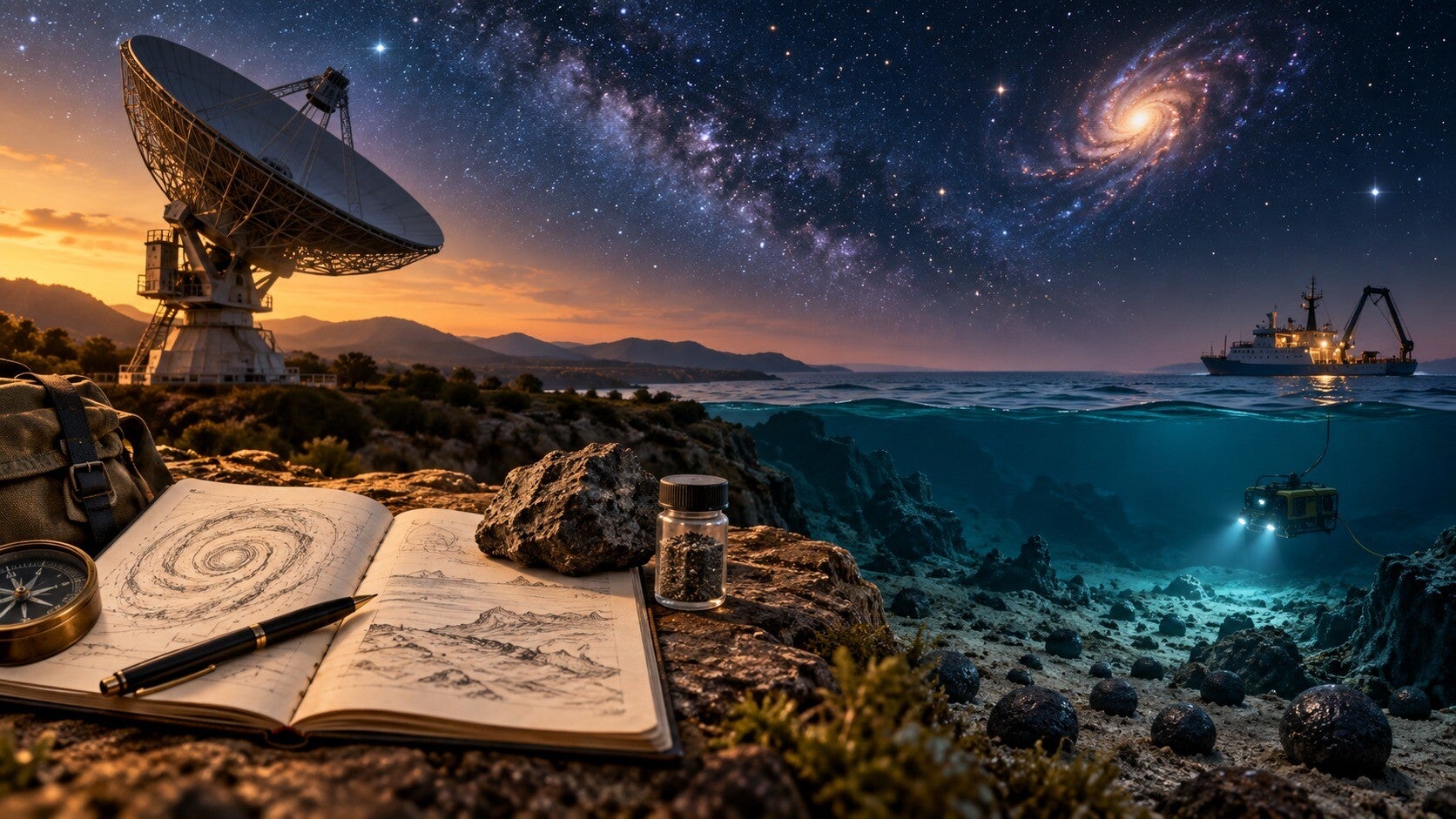
Research and access note: This edition draws on primary abstracts, official research accounts and clearly identified institutional material syndicated by ScienceDaily. Source access differs by story and is disclosed locally. Older leads are retained as dated background rather than relabeled as today’s discoveries. Conceptual images do not constitute experimental evidence.
Add comment
Comments