

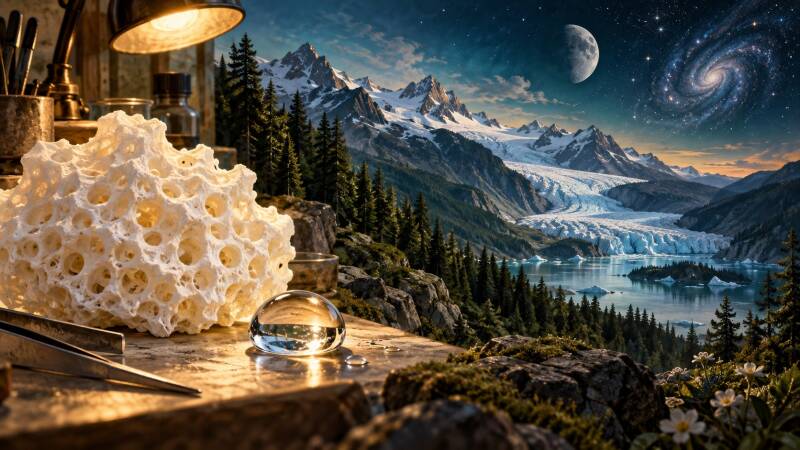
AI-generated editorial illustration: imagined materials, landscapes, and celestial objects. Not a photograph, experimental result, or scale diagram.
Resume repeats the current short passage.
OMEGA SCIENCE EXPLORER ALMANAC
Daily Science Signal · Sunday, September 13, 2026
Hidden Structure, Clearer Signals
White without pigment. Quantum correlations. New ways to read the Moon—and the future of ice.
The Listening Edition
Pull up a chair
Welcome to the Omega Science Explorer Almanac. It's September thirteenth, twenty twenty-six. Today's signal: Hidden Structure, Clearer Signals.
Ever looked at something you've passed a hundred times and suddenly noticed a detail that changes the whole picture? Science has days like that, too. A material gets a useful new structure. An old telescope archive gives up a surprise. A faded wall starts telling a story again.
Let's take these discoveries one at a time. You don't need a physics degree. You need a little curiosity, and a willingness to ask, “All right, but how does that work?” That's a perfectly respectable starting point.
White without the paint bucket
Start with snow. A piece of clear ice lets light through. A pile of snow looks white because light gets scattered among all those ice crystals and air pockets. Different arrangement, different appearance.
Researchers have used a related idea in plastic. They treat a light-sensitive polymer, then use a solvent to help form tiny pores. Those internal boundaries scatter light. By controlling the structure, the team can make white and grayscale patterns. Changes in surface texture also produce strongly water-repellent surfaces.
The technical name is deep-foam photolithography. That's a mouthful, so keep the useful picture: light helps write the pattern, and tiny empty spaces help produce the appearance.
Think of light trying to get through a room full of people who keep sending it in another direction. It's getting the family-reunion directions treatment. The actual process is scattering at material boundaries, of course; the light isn't stopping to ask anybody.
Here's the engineering lesson. An empty space isn't automatically a defect. Put it in the right place, at the right scale, and it can do a job.
But a clever sample isn't a finished production line. Cost, durability, processing chemicals, and disposal still need attention. Pigment-free tells us something specific. It doesn't certify the whole process as harmless.
Reading the tracks after a particle collision
Now for the particle collider. Stay with me; we can leave the equations on the bench for a minute.
The ATLAS experiment reports strong evidence of a quantum connection called entanglement between the spins of paired Z bosons. These are short-lived particles, so researchers don't just point a camera at them and watch. They study the directions of particles left by the decays.
Imagine investigating a machine failure by looking at where the pieces landed. Those directions can tell you something about what happened before. That's the role of the analogy here: understanding why the aftermath contains information.
The quantum part goes beyond ordinary machine parts. Entanglement means the joint system cannot be fully described as two independent quantum states. Researchers test whether the observed patterns fit an entangled system better than a separable one.
The strongest test favors the entangled explanation, with an important condition: it uses assumptions from the Standard Model, our established particle-physics framework. This isn't a report that physics has fallen apart. It's a demanding check of how well the framework holds together.
The paper reached its journal-publication milestone this week. The result itself had already been shared earlier. A new publication date doesn't mean the experiment happened yesterday.
An inspection assistant for the Moon
From tiny particles, let's head to a very large inspection job: mapping the Moon.
NASA and IBM released an artificial-intelligence model trained on roughly two million lunar image tiles. It can be adapted to tasks such as mapping craters and estimating where polar ice could remain stable.
Picture handing an inspector a warehouse full of photographs. Even a very good inspector needs help sorting that mountain. A trained model can help find patterns and narrow the search. Researchers still have to check what those patterns mean.
Here's the distinction that matters. Finding conditions where ice could survive is like finding a shady spot where an ice chest might stay cold. It doesn't prove somebody left an ice chest there.
The model is a tool for investigation. An estimated favorable location is not a measured ice deposit. Lighting can also change what a crater looks like, so good benchmark results don't make the tool right in every circumstance.
The telescope archive with another story to tell
Sometimes the next discovery is waiting in measurements we already have.
Researchers searching Chandra's archive identified eighty-four unusual X-ray sources across six galaxies. They stand out at the lower-energy end of the X-ray range and fade from higher-energy views.
Think of listening to a recording with one range of sound turned down. You might miss something that becomes obvious when you listen differently. Here we're talking about X-ray energies, not sound, but the lesson carries over: what your instrument lets through shapes what you notice.
Some sources might involve compact objects drawing material from companion stars. That's a possible explanation, not a settled identity for the whole group.
And that's a worthwhile discovery in its own right. Sometimes progress means finding a better question before you find the answer. “We don't know what all these are yet” can be the beginning of serious work, not a failure of it.
A glacier forecast is not an appointment
Back on Earth, a newly launched glacier explorer lets people compare projections for individual glaciers under different warming scenarios.
Big global averages are hard to picture. A valley you recognize gives the question a place to stand.
Think about estimating how long a bank balance lasts. Your answer changes with what comes in, what goes out, and the assumptions you make. A glacier has a physical balance involving accumulation and loss. The analogy helps explain why different conditions produce different futures; the actual ice models are much more involved.
So a projected disappearance date is not an appointment written into nature's calendar. It is an answer to a conditional question: under this scenario, what does the model project?
That doesn't make the result useless. It tells us how to use it honestly. Compare scenarios. Look at the assumptions. Don't turn a forecast into a countdown clock with false precision.
Bringing faded artwork into view
Our last main story starts with a familiar frustration: an old picture where you can barely make out the details.
NASA's new retrospective explains how a technique for enhancing satellite images found another use in archaeology. Through software called DStretch, subtle color differences can be made easier to see, helping faded pigments stand out.
Think of separating several nearly identical threads so you can follow each one. The processing strengthens contrasts already present in the image. It doesn't give the computer permission to invent the picture you hoped to find.
And making a mark visible doesn't establish who made it, when, or what it meant. Those questions need other evidence.
The Angkor Wat paintings discussed in the feature were discovered between twenty ten and twenty twelve. The feature is new; those discoveries are older. Keeping that straight is part of respecting the work—and the reader.
Three things to keep on the workbench
Before we go, three earlier September developments deserve a careful follow-up.
First, a study found longer median lifespan in semaglutide-treated female mice than in controls. The reported medians were eight hundred thirty-four days and seven hundred forty-two days. Those are study results in female mice, not a promise about human life.
Separate comparisons with calorie restriction give researchers reasons to investigate effects beyond eating less. They don't justify starting or changing medication to chase longevity. Hope deserves better than a shortcut past the evidence.
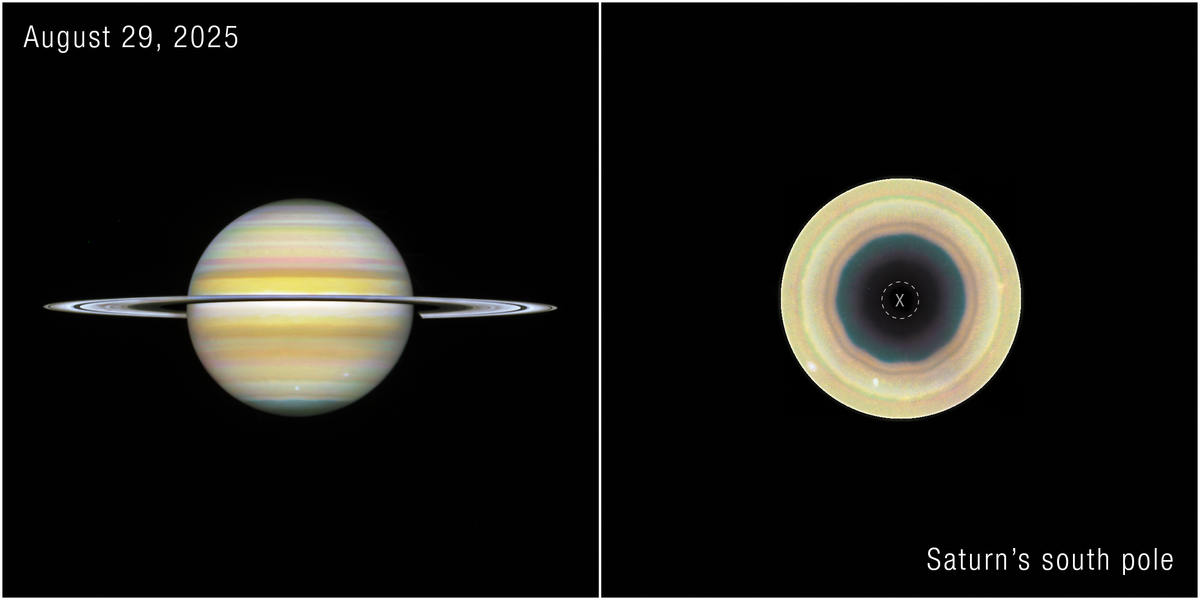
Second, Hubble observations show an evolving ten-sided atmospheric wave around Saturn's southern polar region. There's no fence or solid decagon up there. It's a pattern in an atmosphere. How it formed and how long it will persist remain questions. Nature has supplied the pattern; scientists still have to work out the explanation.
Third, Anthropic reported a machine-checked formalization of Fermat's Last Theorem. Think of the distinction between having an engineering argument and translating every necessary step into a form a checker can verify. That comparison captures the checking job, not the mathematics itself.
The announcement concerns formalizing an existing result, not discovering the theorem for the first time. We haven't independently rebuilt that proof for this edition, so we're identifying it as the company's report.
Take a closer look
What's the thread through all of this? Better ways to look, and better habits for deciding what we're looking at.
A pore can help shape a material's appearance. A decay pattern can test a quantum relationship. An enhanced photograph can reveal a trace of human expression. None needs an exaggerated headline to be worth your attention.
If you'd like a small job of your own, the linked NASA introduction to Artifact InSPECtor explains how volunteers can help identify unwanted signals in telescope data. Start with the tutorial. Learning to recognize what doesn't belong is part of learning what to trust.
The research notes below carry the sources, dates, and limits behind this story. Keep your curiosity. Bring your questions. And don't be embarrassed to ask for the plain-English version.
Wonder. Observe. Discover.
Research Notes & Sources
The detailed reporting below keeps the study dates, evidence labels, image credits, and source links available for a closer look.
Opening Signal
What can you do with a better look? Sometimes you can give a material a new job. Sometimes you can find a pattern hidden in years of measurements. And sometimes you discover that the most interesting question is still unanswered.
This Sunday’s journey runs from a white polymer foam to the machinery of particle physics, then outward to the Moon and distant galaxies before returning to Earth’s glaciers and traces of ancient art. The connecting thread is practical curiosity: look carefully, explain the mechanism, and distinguish a promising result from a finished answer.
[T] Source-supported · [I] Editorial inference · [H] Hypothesis or proposed application · [U] Unresolved. A source-supported claim remains open to revision.
The News Brief
- Materials: [T] A patterned polymer foam creates structural whiteness and water-repellent surfaces. Explore the material.
- Quantum physics: [T] ATLAS reports strong evidence for entanglement between Z-boson spins. Read the evidence.
- AI and space: [T] A released lunar model helps analyze surface features; Chandra’s archive reveals unusual X-ray sources. Look closer.
- Earth: [T] An interactive glacier map makes warming scenarios local. Explore the projections.
- Archaeology: [T] A new feature revisits how image enhancement reveals faded artwork. Follow the technique.
The Big Discoveries
01 · Materials & Engineering
Making white by building the right empty spaces
Peer-reviewed laboratory research · Nature · September 9, 2026
What happened. [T] Researchers developed deep-foam photolithography: a way to pattern polymers into porous structures that produce white and grayscale images, along with surfaces that strongly repel water. Qin and colleagues, Nature.
How it works. [T] Light modifies a photosensitized polymer; a weak solvent then drives pore formation and expansion. Controlled collapse changes the surface texture. The work demonstrates patterning in films and fibers, with resolution around 20,000 dots per inch.
Why it matters. [I] An empty space can be a functional part of a material. Instead of treating pores as defects, engineers can use them to control appearance and wetting. That suggests useful design possibilities for printing and fluid handling.
The boundary. [U] These results do not establish lower lifetime environmental impact or lower manufacturing cost than existing products. Durability, processing requirements, and end-of-life behavior still matter. “Pigment-free” is a specific achievement, not proof that the entire manufacturing process is harmless.
02 · Particle Physics
A quantum relationship survives the violence of a collider
Peer-reviewed publication milestone · Physical Review Letters · September 11, 2026; preprint March 27
What happened. [T] ATLAS reports strong evidence of entanglement between the spins of Z-boson pairs associated with Higgs decays. Its most sensitive test disfavors a separable-state explanation at 4.7 standard deviations relative to the entangled Standard Model hypothesis. Published paper and metadata.
How it works. [T] Researchers analyze the directions of the resulting charged leptons—particles that carry information about the decay. Their angular distributions allow tests of the parent system’s quantum correlations. ATLAS abstract and preprint.
Why it matters. [I] This extends the experimental reach of entanglement studies into massive vector bosons. The interest is in checking quantum behavior under demanding conditions.
The boundary. [T] The highest-sensitivity test relies on Standard Model assumptions about the decays. [U] It is not evidence of physics beyond that model. This week’s milestone is journal publication; the result was already publicly available.
03 · AI & Planetary Science
A lunar image archive gets a new set of tools
Open model and dataset announcement · NASA · September 10, 2026
What happened. [T] NASA and IBM released a lunar foundation model trained on roughly two million image tiles, supporting tasks such as crater mapping and estimating polar ice stability. NASA’s release.
How it works. [T] Broad pre-training provides a starting point that can be adapted to particular mapping tasks. NASA reports that the model matched or exceeded its tested baselines across evaluated tasks, with a clear advantage on ice-stability estimation.
Why it matters. [I] Think of an assistant sorting an enormous inspection archive. It can help surface relevant patterns, giving researchers more time to ask what those patterns mean.
The boundary. [U] Estimating conditions where ice could survive does not demonstrate an actual ice deposit. Lighting changes can affect crater visibility, and benchmark performance is not a universal reliability guarantee.
04 · Astronomy
The objects that show up when you lower the energy
Archival observational study · NASA report September 9, updated September 11, 2026
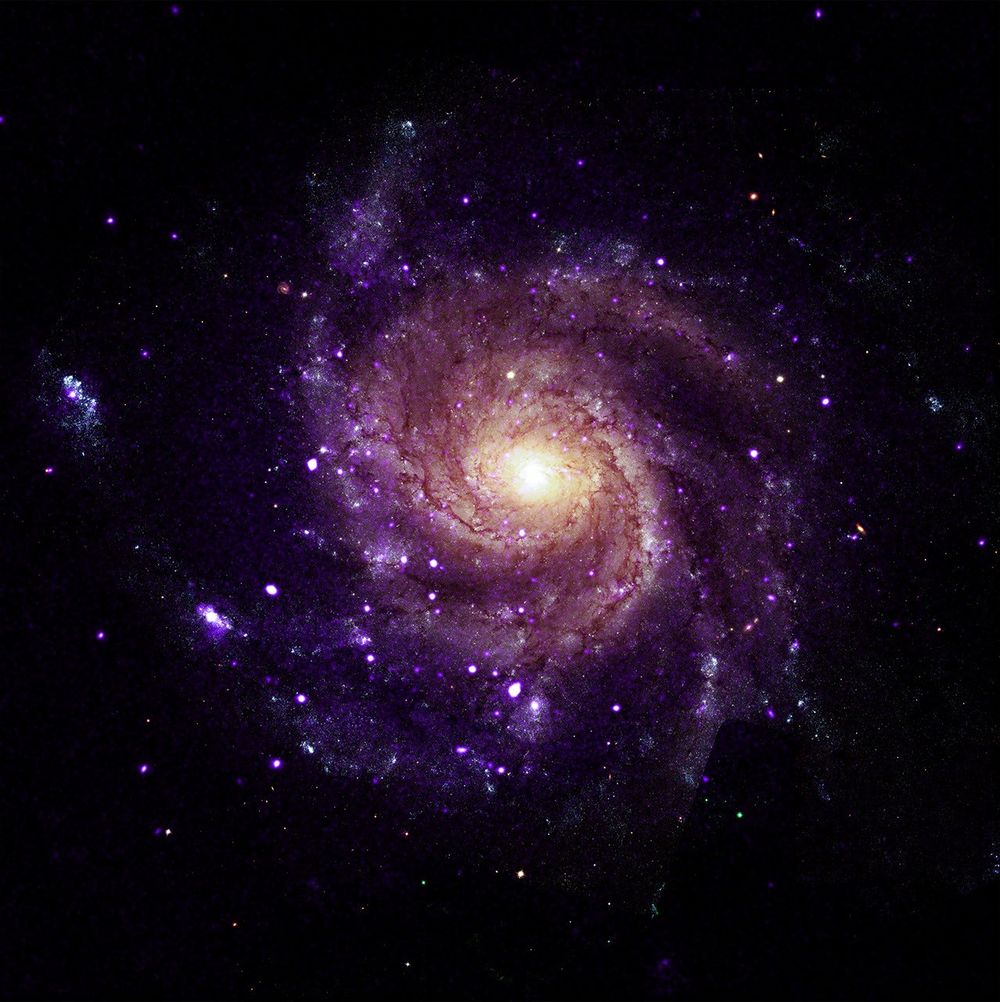
What happened. [T] Researchers found 84 hypersoft X-ray sources in six galaxies using Chandra’s archive. NASA’s account.
How it works. [T] The sources appear in low-energy X-ray images and fade from higher-energy views. Their spectra imply substantial ultraviolet emission.
Why it matters. [H] Some may be compact objects drawing material from companions, potentially offering clues about systems that precede Type Ia supernovae.
The boundary. [U] Their physical identities remain uncertain. A distinctive observational category does not yet settle the mechanism. NASA reports the study’s publication in Nature Astronomy; this edition relies on its institutional summary.
05 · Earth & Climate
Put a place you know on the glacier map
Public visualization launch · VUB · September 11, 2026
What happened. [T] The Global Glacier Extinction Explorer translates published research into projections for individual glaciers under different levels of warming. VUB announcement.
How it works. [T] Users compare whether, and approximately when, a glacier is projected to disappear as the warming scenario changes. The platform builds on a Nature Climate Change study.
Why it matters. [I] An average for the entire planet can be hard to grasp. A familiar valley gives the question a location, making assumptions and consequences easier to discuss.
The boundary. [U] A model’s disappearance date is conditional, not an appointment. VUB also says final Alpine end-of-summer measurements are still underway; preliminary concerns about 2026 are not a completed annual ranking.
06 · Archaeology & Imaging
When a space-imaging method finds a second life in archaeology
New retrospective feature · NASA · September 8, 2026
What happened. [T] NASA revisits how decorrelation stretch moved from remote-sensing imagery into archaeological work through Jon Harman’s DStretch software. NASA’s feature.
How it works. [T] The technique enhances color contrasts, helping faded pigments stand out. The feature includes original and processed views of rock art.
Why it matters. [I] Useful engineering ideas can travel. A method developed to distinguish surface features can also help examine traces of human expression.
The boundary. [U] Enhancement does not independently establish age, authorship, or meaning. [T] The Angkor Wat paintings discussed were discovered in 2010–2012. September 8 is the feature’s publication date, not the date those paintings were found.
Almanac Follow-ups
A longevity result—with “female mice” kept in the headline
[T] A Nature paper published September 2 reports median lifespans of 834 days in semaglutide-treated female mice and 742 days in controls. Treatment began at 20 months of age. Separate comparisons with matched calorie restriction found overlapping benefits and some differences in memory, exploratory behavior, and glucose control. Feng and colleagues, Nature.
[H] Those differences motivate investigation of effects beyond reduced food intake. [U] They do not establish longer human lifespan. This animal result is not a reason to start or change medication for longevity.
Saturn’s ten-sided wave is real; its future is unknown
[T] NASA’s September 2 report describes an evolving southern atmospheric decagon, supported by Hubble observations extending back to 2023. [U] How it formed and how long it will last remain questions for observations and modeling. NASA/Hubble report.
Fermat: a milestone in checking mathematics
[T] On September 4, Anthropic reported a complete Lean formalization of Fermat’s Last Theorem, produced largely autonomously by Claude over 11 days. [I] The important distinction is formal verification of an existing mathematical result, rather than a new discovery of the theorem. [U] The released proof has not been independently rebuilt for this edition. Anthropic’s account and artifact links.
The Almanac Lens
[I] The useful connection is not a hidden law tying every story together. It is a way of working: separate the object from the instrument, the measurement from the model, and the model from its possible applications.
A promising foam still needs a manufacturing assessment. A glacier projection still depends on a scenario. A mathematical argument still needs a checker. The wonder survives those distinctions. In fact, it becomes more interesting when we can say exactly what changed—and what question to ask next.
One Thing to Explore
Try the introductory tutorial for Artifact InSPECtor. [T] NASA’s September 11 announcement invites volunteers to help identify unwanted signals in telescope data. It describes using Euclid data now and Roman data beginning in early 2027. Start with NASA’s project introduction. The question is a good one for any curious reader: what makes a signal worth trusting?
Sources & Transparency
AI-assisted reporting. Sources and uncertainties are identified for reader review.
Primary papers, publisher records, and institutional reports are linked beside the claims they support. The Nature materials paper’s accessible abstract and supporting page were reviewed; its subscription-only main text was not. ATLAS publication metadata and abstracts were checked. Institutional summaries support the lunar, X-ray, glacier, and archaeology reports. No independent experiment, clinical review, or Lean proof rebuild is claimed.
- Qin et al., Foaming photopolymers as a high-resolution biomimetic printing platform. Nature, September 9, 2026.
- ATLAS Collaboration, Measurements of Z-Boson Pair Entanglement in Decays of Higgs Bosons at the ATLAS Experiment. Physical Review Letters 137, 111804, September 11, 2026.
- NASA, NASA, IBM Launch AI Foundation Model for Lunar Science. September 10, 2026.
- NASA, NASA’s Chandra Unveils Mysterious X-Ray Objects. September 9, updated September 11, 2026.
- VUB, When will your glacier disappear? From projections to reality. September 11, 2026.
- NASA, NASA Technique for Manipulating Satellite Photos Now Reveals Ancient Images. September 8, 2026.
- Feng et al., Late-life semaglutide treatment slows ageing and extends lifespan in female mice. Nature 657, 469–476, September 2, 2026.
- NASA/Hubble, NASA’s Hubble Tracks New Decagon Encircling Saturn’s South Pole. September 2, 2026.
- Anthropic, Formalizing Fermat’s Last Theorem. September 4, 2026.
- NASA, Help Refine Data from Space Telescopes with Artifact InSPECtor. September 11, 2026.
Add comment
Comments