

Ω NEWS BRIEF
SCIENCE DESK — DISCOVERY REPORT
Sunday, September 27, 2026
OPENING SIGNAL
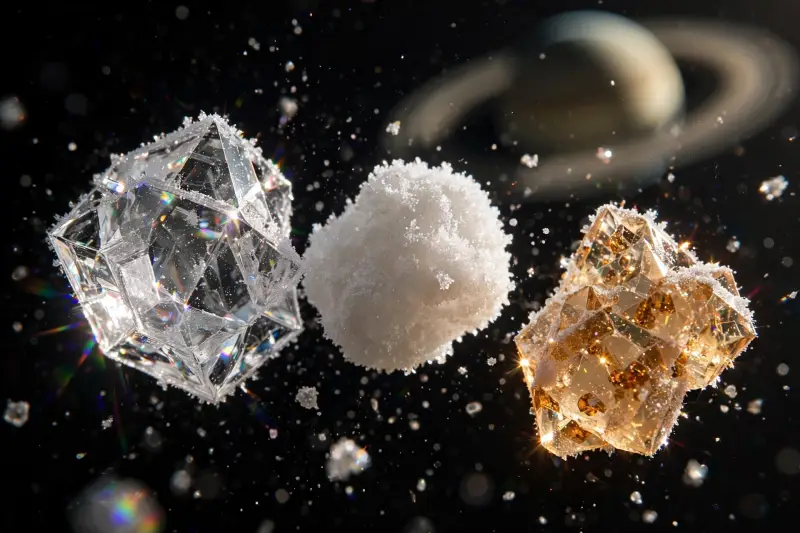
Cassini’s Cosmic Dust Analyzer just paid a late dividend. A new Science Advances analysis of nearly one thousand Type-3 ice grains from Saturn’s E ring shows Enceladus’s ocean spray does not freeze as a uniform salty slush. It freezes slowly, then shatters, sorting salts into chemically distinct micrometeoroids. [T] That is not a press-release flourish. It is a measurable change in how a future plume fly-through can hunt for life.
1. THE BIG DISCOVERIES
[T] Enceladus ice grains sort their salts
WHAT HAPPENED: Frank Postberg and colleagues reanalyzed about 961 Cassini CDA mass spectra of salt-rich Type-3 grains and found at least five compositional subtypes dominated by sodium chloride, carbonates, phosphates, hydroxides, or potassium salts. Lab freezing plus thermodynamics match the data only if droplets tens to hundreds of micrometers freeze slower than about 20 kelvin per minute, then fragment in the vents.
WHY IT MATTERS: The plume is a pre-sorted sample of the ocean, not a homogenized spray. Phosphate-rich grains and organic-bearing grains can be inspected one particle at a time.
WHAT IT COULD BECOME: A fly-through mass spectrometer on a planned Enceladus mission can treat single grains as miniature ocean vials. Companion work this week argues Enceladus-like chemistry can still support methanogenesis under extreme carbon-dioxide limitation. [I]
WHAT IT MEANS FOR YOU: The cheapest path to a yes-or-no answer on life in this solar system just got more specific. Design, not poetry.
[T] NASA picks PRIMA as first Probe-class far-infrared telescope
WHAT HAPPENED: On September 23 NASA advanced PRIMA, a 1.8-meter far-infrared observatory, into Phase B. Cost cap is 1.2 billion dollars excluding launch. Target launch is 2033 for a five-year mission. Detectors are kinetic inductance sensors intended to be about 100 times more sensitive than Herschel’s.
WHY IT MATTERS: Far-infrared astronomy has been dark since Herschel died in 2013. Cool dust, protoplanetary-disk mass, and galaxy growth hide there.
WHAT IT COULD BECOME: A standing middle tier between Explorers and flagships, if Phase B survives confirmation.
WHAT IT MEANS FOR YOU: The next decade of planet-formation physics now has a funded instrument class, not only a wishlist.
[T] Youngest confirmed exoplanet still accreting
WHAT HAPPENED: Elias 2-24b is reported as less than one million years old and still embedded in its natal disk, making it the youngest confirmed exoplanet on current tallies. [T] Mass is still being assembled. Interpretation of exact mass-growth rate remains model-dependent. [I]
WHY IT MATTERS: Planet formation is usually inferred after the fact. This object is caught mid-construction.
WHAT IT COULD BECOME: A calibration target for disk chemistry and migration timescales once JWST and ground-based high-contrast data stack.
WHAT IT MEANS FOR YOU: The Solar System’s first million years are no longer only a simulation.
[T] Laser-driven muons imaged through walls
WHAT HAPPENED: Science reported the first clean pictures from a laser-generated muon beam used to see through opaque objects, with applications proposed for packages and archaeology. [T] This is a laboratory demonstration, not a fielded scanner. [I]
WHY IT MATTERS: Cosmic-ray muon tomography is slow and bulky. A compact source changes the engineering envelope.
WHAT IT COULD BECOME: Non-destructive inspection if flux, dose, and cost scale. That scaling is unproven. [U]
WHAT IT MEANS FOR YOU: A new way to look inside matter without opening it. Not yet a product.
[T] Diamond quantum sensors aimed at the heart
WHAT HAPPENED: Separate September 27 reports describe diamond nitrogen-vacancy sensors small enough for compact magnetometry and photonic circuits built around diamond beams for quantum networks. [T] Clinical superiority over existing cardiac monitoring is not demonstrated. [U]
WHY IT MATTERS: Quantum sensors leave the physics bench when they measure something a hospital already cares about: weak magnetic fields from the heart.
WHAT IT COULD BECOME: Wearable magnetocardiography if noise, temperature, and cost collapse.
WHAT IT MEANS FOR YOU: The first quantum device most people may wear will not be a computer. It will be a sensor.
2. SPACE / COSMOS
[T] Cassini E-ring grains remain the only direct samples of an extraterrestrial ocean. The new segregation result is the week’s strongest planetary-science paper.
[T] NASA selected PRIMA to reopen the far-infrared after a 13-year gap.
[T] Hubble completed its 200,000th Earth orbit this month while still hunting lensed supernovae.
[I] Reports of a triple active-galactic-nucleus system about 1.2 billion light-years away, if confirmed, give a rare live view of hierarchical black-hole assembly. Independent redshift and dynamical confirmation still needed. [U]
[H] Popular claims of “caves perfectly built to shelter life on Mars” overreach current orbital morphology. Terrain exists. Habitability is not demonstrated.
3. PHYSICS / QUANTUM
[T] CERN has begun disconnecting sections of the Large Hadron Collider so aging hardware can be replaced ahead of the high-luminosity era. This is maintenance physics, not a new particle.
[T] Science published work on antiferroelectric hafnia remaining functional down to the two-dimensional limit, relevant to dense memory.
[I] Diamond beams as on-chip quantum-network elements are an engineering path, not a completed network.
[U] Isolated anomalous events in underground dark-matter detectors continue to appear in secondary coverage. No named collaboration this week has claimed a particle discovery. Treat lone signals as UNKNOWN until a collaboration paper exists.
4. AI + SCIENCE
[T] NIH described a 170-million-dollar reproducibility push, including literature tools. That is institutional process, not a new law of nature.
[I] AI-guided mutation of bacteriophages was reported to raise infection of target bacteria by large factors in lab assays. Dual-use and ecological risk sit next to the capability. Replication and containment details are incomplete in secondary reports. [U]
Ordinary product-chatbot news is excluded. No confirmed AI-as-instrument result this week outranks the Enceladus grain catalog or PRIMA selection.
5. ENGINEERING / MATERIALS / ENERGY
[T] Hafnia antiferroelectrics at the 2D limit matter for capacitors and memory density.
[T] Earlier 2026 perovskite-module papers showed outdoor stability over thousands of hours with polymer electron-transport layers replacing fragile fullerenes. Those results remain the practical energy benchmark this month, even if they are not 24-hour news.
[I] Self-healing UV-triggered hydrogel contact lenses appeared in multiple outlets. Useful if scratch-healing survives tear-film chemistry and regulatory testing. Not yet a clinical standard. [U]
[T] LHC hardware swap is the largest particle-physics engineering job on Earth right now.
6. EARTH / LIFE / HUMAN ORIGINS
[T] Ancient DNA from medieval Swedish graves that looked like family groups often were not close kin. Burial practice is social, not only genealogical.
[T] Large-scale mapping of feline tumor genomes found shared pathways with human cancers, a comparative-oncology resource rather than a therapy.
[I] A 2-billion-year-old carbon-isotope excursion long read as a global biosphere event may instead record local magmatic processes. If the reinterpretation holds, one famous Earth-system marker loses global status.
[T] A geothermal amoeba reported thriving near 63 degrees Celsius pushes the known thermal envelope for eukaryotic cells. Mechanism and independent culture confirmation still matter. [I]
[T] A digital facial approximation of the Jebel Irhoud hominin, about 315,000 years old, is an anatomical reconstruction, not a photograph of a person.
[I] The North Pole Dome structure in Western Australia is argued at about 3.02 billion years and would be Earth’s oldest dated impact crater and the only accepted Archean example. Age is still contested by other impact specialists. [U]
7. THE PAPER OF THE DAY
Frank Postberg et al., Science Advances, 25 September 2026. “Cassini CDA observes compositional segregation of Enceladus’ ice grains from slow freezing and fragmentation of oceanic spray.”
QUESTION: Are Type-3 salt-rich grains uniform frozen ocean droplets, or do they record a more complex freeze-and-shatter path?
METHOD: About one thousand individual CDA mass spectra from E-ring grains; laboratory freezing of analog brines; thermodynamic precipitation calculations.
RESULT: At least five salt-dominated subtypes. Segregation requires large droplets and slow cooling, then mechanical fragmentation in vents.
EVIDENCE GRADE: [T] for the spectral diversity and the laboratory match to the proposed freeze path. [I] for the exact vent-flow geometry.
LIMITATIONS: CDA sampled E-ring grains, which are processed after ejection. Instantaneous plume composition at the tiger stripes is inferred, not directly clocked grain-by-grain in this paper. No biosignature is claimed.
WHY IT MATTERS: Future life-search instruments can be built for single-grain chemistry instead of bulk averages.
8. WHY THIS MATTERS TO YOU
If you care about whether life exists beyond Earth, this week improved the sampling strategy, not the answer. If you care about seeing how planets and galaxies assemble, NASA just funded the missing far-infrared eye. If you care about devices, the near-term quantum hardware that may touch daily life is a diamond sensor, not a million-qubit computer. None of that requires believing a headline. It requires watching which measurements get cheaper.
9. REALITY CHECK
WHAT WE KNOW: Enceladus grains are chemically segregated. [T] PRIMA is in Phase B, not on the pad. [T] LHC upgrade work has started. [T] Medieval co-burial is not a reliable kinship map. [T]
WHAT WE THINK: Sorted grains make biosignature hunts easier. [I] Far-infrared disk masses will rewrite planet-formation timelines once PRIMA flies. [I] Diamond magnetometers can leave the lab. [I]
WHAT WE DON'T KNOW YET: Whether any Enceladus grain contains biology. [U] Whether PRIMA survives confirmation and cost control. [U] Whether the Pilbara impact age will hold against critics. [U] Whether laser-muon imaging scales beyond a demonstration. [U]
HYPE WATCH: Mars “alien caves,” lone dark-matter blips, and any claim that a new sensor “will transform” medicine before a controlled clinical comparison. Those are [H] or [U] until a named instrument paper and a replication exist.
CLOSING SIGNAL
If you remember one thing: Enceladus is already sending us pre-sorted vials of its ocean. The next mission does not have to invent a new ocean. It has to catch the right grain.
Add comment
Comments