

Ω NEWS BRIEF
SCIENCE DESK — DISCOVERY REPORT
Saturday, September 26, 2026
OPENING SIGNAL
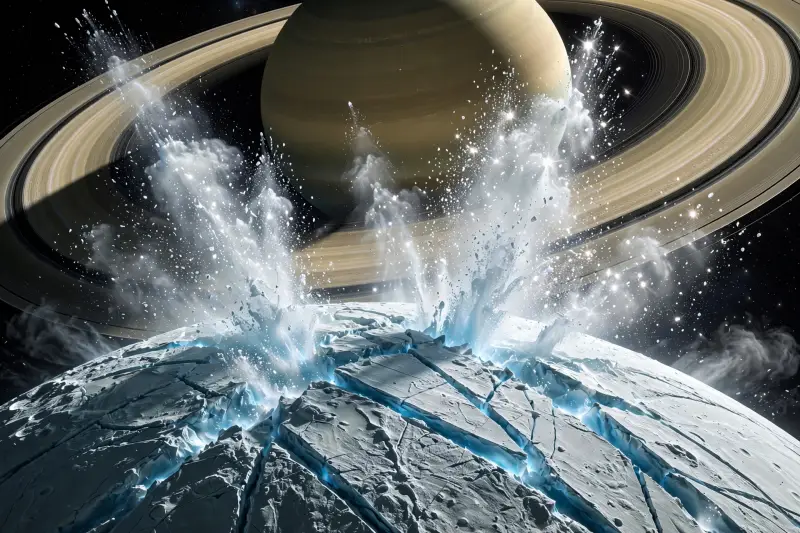
Enceladus just became a better target, not because anyone found life, but because two peer-reviewed papers show how its ocean chemistry is sorted into individual ice grains and that an Earth methanogen can run under Enceladus-like alkalinity and oxygen starvation. [T] That is a measurement-and-habitability update, not a detection.
1. THE BIG DISCOVERIES
[T] Enceladus ice grains chemically sort the ocean
WHAT HAPPENED: Cassini Cosmic Dust Analyzer spectra of about 1,000 Type-3 ice grains show at least five salt-dominated subtypes — chloride, carbonate/bicarbonate, phosphate, hydroxide, and potassium salts — rather than one mixed ocean snapshot. Thermodynamic work and lab freezing imply large droplets freeze slowly in vents, salts precipitate in sequence, then wall collisions shatter them into chemically purer fragments. Source: Postberg et al., Science Advances, 25 Sep 2026.
WHY IT MATTERS: Plume grains are not noisy averages. They are fractionated packets. Organics and possible biosignatures would concentrate in specific grain classes.
WHAT IT COULD BECOME: Future fly-through mass spectrometers can target NaCl-rich fragments first instead of integrating the whole plume.
WHAT IT MEANS FOR YOU: The next Enceladus mission does not need a lander to get a chemically useful ocean sample. It needs grain-by-grain analysis.
[T] Methanogens survive an Enceladus-ocean analog
WHAT HAPPENED: A companion Science Advances paper reports that Methanothermococcus okinawensis can produce methane under extreme CO2 limitation, high alkalinity, and oxygen about 10,000 times lower than Earth’s atmosphere in a lab chamber meant to mimic Enceladus seafloor chemistry. Source: Helmbrecht, Postberg, Khawaja et al., Science Advances, 25 Sep 2026.
WHY IT MATTERS: One of Earth’s oldest metabolisms is not immediately ruled out by the moon’s inferred geochemistry.
WHAT IT COULD BECOME: A constraint on habitability, not proof of inhabitants. Survival in a chamber is not colonization of a moon.
WHAT IT MEANS FOR YOU: The search for life in the solar system now has a tighter experimental floor and a cleaner sampling strategy.
[T] Laser-made muons imaged lead through a concrete wall
WHAT HAPPENED: At ELI-NP in Romania, a high-power laser produced a particle beam sent through a two-meter concrete wall into detectors in a van. After filtering, researchers report the first images dominated by laser-generated muons, including the shadow of lead blocks. Source: Science news report 25 Sep 2026 on an arXiv preprint; first clean demonstration of laser-driven muon imaging claimed by the team.
WHY IT MATTERS: Cosmic-ray muography is slow and passive. An on-demand muon beam would make dense-object imaging scheduled rather than accidental.
WHAT IT COULD BECOME: Inspection of cargo, nuclear material, or buried archaeology without opening the object. Scale, dose, and portability remain open.
WHAT IT MEANS FOR YOU: Seeing through walls is no longer only a cosmic-ray waiting game. It is an accelerator-physics engineering problem.
[I] Claude agents flagged a CRISPR-like phage enzyme system; function unknown
WHAT HAPPENED: Anthropic reports that roughly 950 Claude agents searched ~1.9 billion metagenomic protein clusters for 21 hours and flagged array-associated reverse transcriptases (ART) in jumbo bacteriophages: an RT, a partner protein of unknown function, and a tandem DNA-repeat array. Lab work confirmed the array is transcribed. Results are a company announcement plus preprint, not a journal paper. Source: Anthropic, 23 Sep 2026; NYT, Reuters, The Verge.
WHY IT MATTERS: Pattern recognition at genome-mining scale can surface overlooked architectures faster than a single human scan.
WHAT IT COULD BECOME: A gene-editing tool only if biochemistry later shows programmable cut/copy/paste. Anthropic and outside CRISPR researchers both say the mechanism is unproven. [H]
WHAT IT MEANS FOR YOU: Treat “AI discovered CRISPR 2.0” headlines as overclaim. The demonstrated result is a candidate system, not a working editor.
[T] Trapped ions simulate string breaking
WHAT HAPPENED: A 13-ion chain at Duke/JQI encoded a string-breaking model. Laser-tuned interactions stretched an effective flux tube until new particle-like excitations appeared, analog of matter popping out of the vacuum. Nature Physics, 23 Sep 2026.
WHY IT MATTERS: A small quantum processor reproduced a non-perturbative process that is hard for classical lattice QCD at real-time dynamics.
WHAT IT COULD BECOME: A path toward collider-relevant and early-universe simulations once qubit count and error rates rise.
WHAT IT MEANS FOR YOU: Quantum computers are starting to do physics that is not just cryptography or chemistry toy problems.
[T] First real-time quantum jumps of sound
WHAT HAPPENED: Stanford researchers watched individual phonons in a long-lived mechanical resonator jump between energy levels in real time, using a superconducting qubit as a witness. Science, reported this week.
WHY IT MATTERS: Quantum jumps were seen in ions (1986) and photons (2007). Phonons close the third common quantum of everyday matter-in-motion.
WHAT IT COULD BECOME: Mechanical qubits, phonon error tracking, and ultra-sensitive force or mass sensors.
WHAT IT MEANS FOR YOU: Sound is quantized in the lab in the same discrete way light is. That is now observed, not only inferred.
2. SPACE / COSMOS
[T] Enceladus items above dominate the week. NASA is advancing PRIMA, a proposed $1.2 billion far-infrared space telescope aimed at a 2033 launch to study galaxy evolution and planet-forming disks in a wavelength band Webb cannot fully cover. [T] Institutional planning, not a discovery.
[T] Harvest Moon and Saturn reach opposition this weekend; observational, not research news.
[I] Reports of radio emission associated with Beta Pictoris b circulated this week; treat as first-look exoplanet magnetosphere work pending full reduction. Limited data in secondary coverage.
[I] Triple active galactic nuclei on a collision course were reported in secondary astronomy outlets. Primary paper not independently re-read here. Flag as cited but not desk-verified in full text.
3. PHYSICS / QUANTUM
String-breaking ions and phonon jumps are the clean experimental results. [T]
[T] ScienceDaily, 25 Sep: researchers report non-Abelian anyons performing a universal set of operations — a hardware-relevant claim that still needs the primary paper read for error rates and encoding overhead.
[I] A Nature Communications game on Quantinuum H2 (up to 55 qubits) showed a complement-sampling task where quantum play beat the best proven classical strategy as size grew. Advantage here is task-specific, not general-purpose supremacy.
Do not confuse these with a fault-tolerant machine. Error correction remains the bottleneck. [T]
4. AI + SCIENCE
Anthropic ART is the week’s instrument story: agents as genome miners, humans as wet-lab validators. Function of ART is UNKNOWN. Replication of the search was inconsistent across reruns unless the flanking DNA was handed to the model directly. [T]/[U]
Google’s planned experimental satellite with enough compute for simple in-orbit AI queries is engineering news, not a scientific result. [T] announcement-level.
Filter: product launches and model scoreboard fights stay out unless they change what can be measured in a lab.
5. ENGINEERING / MATERIALS / ENERGY
[T] Self-healing hydrogel contact lenses that close scratches under about one hour of UV light were reported across EurekAlert and engineering outlets on 25 Sep. Mechanism is photochemical polymer repair, not magic coating. Durability in tears and regulatory path are unshown.
[I] Fungi proposed as partners for growing crops in lunar and Martian regolith (ScienceDaily, 25 Sep): mycorrhizal help with nutrient access is biologically plausible; flight-ready agriculture is not demonstrated.
Laser-muon imaging belongs here as much as in physics: compact sources still need filters, dose models, and fieldable detectors.
6. EARTH / LIFE / HUMAN ORIGINS
[T] A new living cat species from Bolivian cloud forest — first newly described living felid in about a century — was genetically distinguished from known tiger-cat lineages (Science News, 24 Sep). Taxonomy, not a sudden appearance of a new animal in the wild.
[T] REM-sleep energy paradox: brain blood supply and fuel rise while net energy balance looks like a drain during dreaming sleep (ScienceDaily, 26 Sep). Mechanism still [H].
[T] Rare flavoalkaloids reported in cannabis leaves for the first time, plus many previously unlisted phenolics. Medical potential is [H] until activity assays exist.
[T] Two new Salish Sea sea-spider species described, including a self-grooming hairy-legged form. Biodiversity inventory, not a technology shift.
North Pole Dome / Miralga impact age near 3.02 billion years is important Earth history but sits outside the last 7 days as a June Geology paper. Mentioned only as background, not today’s result.
7. THE PAPER OF THE DAY
Frank Postberg et al., “Cassini CDA observes compositional segregation of Enceladus’ ice grains from slow freezing and fragmentation of oceanic spray,” Science Advances 12 (39), 25 September 2026. DOI 10.1126/sciadv.aee7256.
QUESTION: Are Type-3 plume grains faithful mixed samples of Enceladus’ ocean?
METHOD: ~1,000 individual CDA mass spectra; lab freezing experiments; thermodynamic precipitation sequences for NaCl, carbonates, phosphates, hydroxides.
RESULT: At least five compositional subtypes. Separation requires parent droplets larger than about 10 micrometers and cooling slower than about 20 K per minute, then fragmentation in vents.
EVIDENCE GRADE: [T] for grain diversity and the inferred two-stage process as the best current physical model. Direct vent imaging does not exist.
LIMITATIONS: Cassini is gone. Grain statistics are from E-ring collection, not a dedicated life-search instrument. Organics were discussed as segregating; no biomolecule identification is claimed.
WHY IT MATTERS: It changes mission design. You sample classes of grains, not “the plume.” Pair with the methanogenesis analog paper the same day.
8. WHY THIS MATTERS TO YOU
If you care about whether we can test life beyond Earth this century, Enceladus moved from “interesting ocean world” to “chemically sorted, fly-through-sampleable ocean world with a demonstrated Earth metabolism analog.” That is operational, not poetic.
If you work with dense, shielded objects — cargo, reactors, ruins — laser-driven muons are the first hint of an active probe instead of waiting on cosmic rays.
If you use AI for science, today’s honest yield is a flagged enzyme family plus a lab confirmation that the DNA array is real. The tool is useful. The function is still a blank.
9. REALITY CHECK
WHAT WE KNOW: Enceladus plume grains are compositionally segregated. [T] An Earth methanogen can metabolize in an Enceladus-like geochemical chamber. [T] Phonon energy jumps and ion-chain string breaking have been observed. [T] A laser-driven beam produced muon-dominated images through concrete in one experiment. [T] at demonstration scale.
WHAT WE THINK: ART enzymes may participate in a CRISPR-like information system in phages. [H] Fungi may help in situ resource utilization on Mars. [H] Non-Abelian anyons may be a practical universal-gate resource. [I] pending hardware papers.
WHAT WE DON'T KNOW YET: Whether anything is alive in Enceladus’ ocean. What ART actually does. Whether laser-muon imaging can leave the national-lab courtyard. Whether quantum simulations of string breaking will outrun classical methods on problems that matter to QCD.
HYPE WATCH: “AI discovered a new CRISPR” and “caves on Mars built to shelter life” are narrative inflation. The first is an uncharacterized repeat-associated RT. The second, in tabloid form, is not a demonstrated habitat.
CLOSING SIGNAL
If you remember one thing: Enceladus does not spray a blended ocean smoothie into space. It sprays sorted ice. That single physical fact makes a life search cheaper, sharper, and sooner than the lander-first story assumed.
Add comment
Comments