

Ω NEWS BRIEF
SCIENCE DESK — DISCOVERY REPORT
Tuesday, September 29, 2026
OPENING SIGNAL
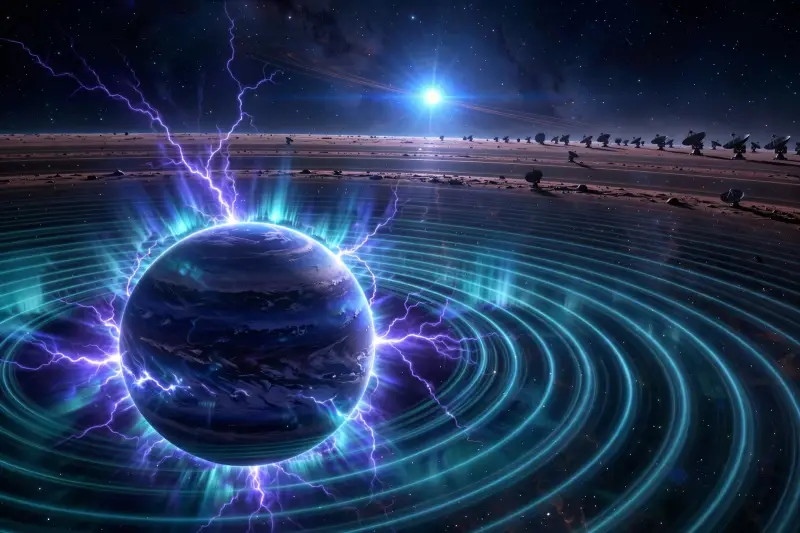
A radio telescope in South Africa has locked onto aurora from a world 64 light-years away. [T] MeerKAT detected highly circularly polarized bursts from the giant exoplanet Beta Pictoris b, not from its star. That is the first time an extrasolar planet’s own magnetic field has been measured directly. The implied field is at least 1.25 kilogauss — thousands of times stronger than Earth’s. Magnetic fields decide whether atmospheres stay or leave. This is no longer a theory about other worlds. It is a measurement.
1. THE BIG DISCOVERIES
[T] FIRST DIRECT RADIO DETECTION OF AN EXOPLANET
WHAT HAPPENED: Ortiz Ceballos, Berger, and Cendes report auroral electron-cyclotron-maser emission from Beta Pictoris b with MeerKAT at 0.85–3.5 GHz across four epochs. Astrometry places the source on the planet, not the star or planet c. Preprint: arXiv:2609.16720.
WHY IT MATTERS: Planetary magnetic fields were inferred, never measured outside the Solar System. Frequency of cyclotron emission scales with field strength at the source.
WHAT IT COULD BECOME: A search method for magnetospheres around other giants and, later, smaller worlds.
WHAT IT MEANS FOR YOU: Habitability is not only temperature and water. It is whether a planet can hold its air against a star.
[T] ENCELADUS PLUME GRAINS ARE NOT TINY OCEAN SCOOPS
WHAT HAPPENED: Postberg et al. analyzed ~1,000 Cassini Cosmic Dust Analyzer spectra of Type 3 ice grains and found at least five salt subtypes. Science Advances, 25 Sep 2026. Lab freezing plus thermodynamics show salt segregation only in droplets larger than ~10 micrometers freezing slower than ~20 K per minute, then shattering in vents.
WHY IT MATTERS: Future plume fly-throughs may sample concentrated packets of organics, not diluted ocean average.
WHAT IT COULD BECOME: A design constraint for Europa and Enceladus life-search instruments.
WHAT IT MEANS FOR YOU: The easiest place to look for alien chemistry may already be spraying it into space, pre-sorted.
[T] LUTETIUM CLOCKS HIT 1 × 10⁻¹⁹ UNCERTAINTY
WHAT HAPPENED: Arnold, Lee, Barrett and colleagues at the National University of Singapore report two ¹⁷⁶Lu⁺ single-ion optical clocks with systematic uncertainty near 1 × 10⁻¹⁹ and a same-lab comparison of 5.7 × 10⁻¹⁹ over 200 hours. Nature, 23 Sep 2026. Room-temperature systems, not cryogenic.
WHY IT MATTERS: This is the tightest optical-clock uncertainty and the tightest published twin comparison to date. [I] It is a candidate for redefining the second and for millimetre-scale gravitational heighting.
WHAT IT COULD BECOME: Chronometric leveling, Lorentz tests, dark-matter searches that look for tiny frequency drifts.
WHAT IT MEANS FOR YOU: Timekeeping is now sensitive enough that a few millimetres of height change the tick. GPS and geodesy will feel this first.
[I] INNER-CORE GRAVITY MAY SET THE LENGTH OF A DAY
WHAT HAPPENED: Zhang and Dumberry model multidecadal length-of-day wobbles (a few milliseconds, 1964–2019) as gravitational torque between a slightly misshapen inner core and mantle density anomalies, resisted by electromagnetic and topographic torques. Nature, 23 Sep 2026. Fit requires viscous deformation of the inner-core boundary on ~decade timescales.
WHY IT MATTERS: Angular-momentum exchange between core and mantle was known. The coupling channel was not.
WHAT IT COULD BECOME: A constraint on inner-core viscosity and on how Earth’s dynamo talks to the crust.
WHAT IT MEANS FOR YOU: Leap seconds, satellite orbits, and radio astronomy already live in this millisecond budget. The engine is 5,000 kilometres under your feet.
[T] A SECOND INDEPENDENT ORIGIN OF PHOTOSYNTHETIC ORGANELLES
WHAT HAPPENED: Van Etten and colleagues describe two new Paulinella species collected during a low-budget field campaign; Journal of Phycology. Known photosynthetic Paulinella species now total six. This lineage acquired a photosynthetic organelle independently of the ancient event that produced chloroplasts in plants and algae.
WHY IT MATTERS: Endosymbiosis that created complex photosynthetic life is no longer a unique historical accident in the fossil record of cells. [I] It happened at least twice.
WHAT IT COULD BECOME: A living laboratory for how genes move from endosymbiont to host nucleus.
WHAT IT MEANS FOR YOU: The machinery that feeds the biosphere is rarer than grass and more repeatable than we thought.
2. SPACE / COSMOS
[T] ESA’s JUICE completed an Earth gravity assist on 28 September, gaining roughly 8,000 mph toward Jupiter and the icy moons. Course correction confirmed by ESA.
[T] CHIME reports a standalone detection of the 21-cm hydrogen glow from when the universe was about five billion years old, opening intensity-mapping of large-scale structure without optical spectroscopy. Astrophysical Journal / UBC release, 28 Sep.
[H] CosmoCube, a suitcase-class far-side lunar radio mission concept, is being advanced to listen for the cosmic dark-ages signal shielded from Earth noise. Concept, not flight hardware.
[U] SciTechDaily summaries of a lunar far-side magnetic structure and of wave-like dark matter constrained by quasar lensing are secondary reports. Limited primary confirmation in the last 24 hours. Treat as [U] until papers are read in full.
3. PHYSICS / QUANTUM
[T] The lutetium result above is the week’s strongest laboratory physics claim: demonstrated frequency uncertainty and a twin-clock comparison, not a proposal.
[I] A 13-ion quantum simulator reported last weekend recreated a particle-production process analogous to early-universe pair creation. Simulation of a model, not a cosmological measurement.
[U] ATLAS evidence for a rare Higgs path to a virtual photon plus a real photon remains “evidence,” not observation, pending full papers and combination with CMS. Do not upgrade.
4. AI + SCIENCE
[I] PNAS lists a foundation model named Mantis for mechanistic disease forecasting (28 Sep). Capability claims require the paper, not the title.
[H] Nature notes Anthropic’s AI biolab reporting CRISPR-like DNA in viruses. Interpret as an instrument result under review, not a rewritten tree of life.
Ordinary product-model news is out of scope. AI matters here only when it measures, predicts, or designs something physical.
5. ENGINEERING / MATERIALS / ENERGY
[T] Researchers applied semiconductor nanoscale patterning to copper current collectors for EV batteries, aiming at more uniform plating and longer cycle life. Engineering demonstration, 28 Sep secondary reports.
[I] Nature Communications reports a solid-oxide electrolysis stack run for 25,000 hours under AC:DC operation. That is a durability data point for green hydrogen, not a factory process yet.
[U] Digestible paper-based batteries tested in pigs remain preclinical. Do not treat as a medical product.
6. EARTH / LIFE / HUMAN ORIGINS
[T] Large MRI analyses associate distinct accelerated-aging patterns with Alzheimer’s, mild cognitive impairment, psychiatric diagnoses, and addiction. Correlation of imaging phenotypes with clinical labels. Not a causal clock you can reset at home.
[T] A 120-million-year-old deltatheroidan from China is reported as a candidate oldest confirmed marsupial-line ancestor, shifting weight toward an Asian split from placentals. Fossil plus phylogenetic inference.
[T] A newly described “fire amoeba” from Lassen Volcanic National Park remains motile near 147°F and reproduces near 145°F. Extends the thermal envelope for complex eukaryotic cells. [I] Does not rewrite the limits of animal life.
[I] Studies of a ~3-billion-year-old Australian impact structure are circulating as the oldest dated crater. Dating methods and field context still need primary-paper audit.
[T] Nature reports transplanted hearts adjusting biological-age markers toward the host. Organ-level plasticity, not immortality.
7. THE PAPER OF THE DAY
Discovery of radio emission from the exoplanet β Pictoris b — Ortiz Ceballos, Berger, Cendes, arXiv:2609.16720, 15 Sep 2026 (coverage through 28–29 Sep).
QUESTION: Can auroral cyclotron emission be spatially assigned to an exoplanet rather than its star?
METHOD: MeerKAT L- and S-band imaging on four epochs; quasar-referenced astrometry; circular-polarization and variability cuts that favor electron-cyclotron maser over plasma or stellar gyrosynchrotron emission.
RESULT: Recurring bursts plus persistent emission coincident with planet b; inconsistent with the star and with planet c; B ≳ 1.25 kG at the source.
EVIDENCE GRADE: [T] for detection and localization within the stated astrometric errors. [I] for dynamo-scaling agreement with a young massive giant. [U] until peer review and independent array confirmation.
LIMITATION: Preprint. Magnetic-field value is a lower bound set by the highest detected frequency, not a full magnetospheric map.
WHY IT MATTERS: It converts “does this planet have a field?” from a model output into an observable.
8. WHY THIS MATTERS TO YOU
Three instruments just moved the boundary of what can be measured: a radio array that hears another planet’s aurora, a pair of ions that keep time to 19 decimals, and a dust analyzer that shows an ice moon sorting its own chemistry. None of these is a consumer product this week. All three change the error bars on questions that already touch navigation, climate of other worlds, and whether a spacecraft can recognize a biosignature if it flies through a plume. If you only track headlines about rockets, you will miss the quieter shift: detection, not destination, is what advanced.
9. REALITY CHECK
WHAT WE KNOW: Radio bursts localized to β Pic b. Cassini Type 3 grains are chemically segregated by a freeze-and-shatter path. Two lutetium clocks agree at 5.7 × 10⁻¹⁹. Length-of-day residuals can be fit by inner-core gravitational torque in one published model. Paulinella diversity increased by two species.
WHAT WE THINK: Strong exoplanet fields are common among young giants. Enceladus organics may concentrate the same way salts do. Inner-core viscosity is lower than a naïve solid sphere suggests.
WHAT WE DON'T KNOW YET: Whether β Pic b’s field protects any atmosphere that matters. Whether concentrated plume grains contain detectable biomolecules. Whether lutetium clocks remain first after independent labs copy the architecture. Whether the inner-core rotation series used in the torque model is unique or one of several seismic solutions.
HYPE WATCH: “Most accurate clock in the world” is a laboratory claim from one group using one species. “Even more promising for life” on Enceladus is an inference from chemistry, not a microbe. Do not promote [I] or [H] to [T] because the sentence sounds finished.
CLOSING SIGNAL
If you remember one thing: another planet’s magnetic field has left a radio fingerprint we can point to on the sky. That is a new kind of fact about worlds that are not ours.
Add comment
Comments