

Ω NEWS BRIEF
SCIENCE DESK — DISCOVERY REPORT
Tuesday, September 22, 2026
OPENING SIGNAL
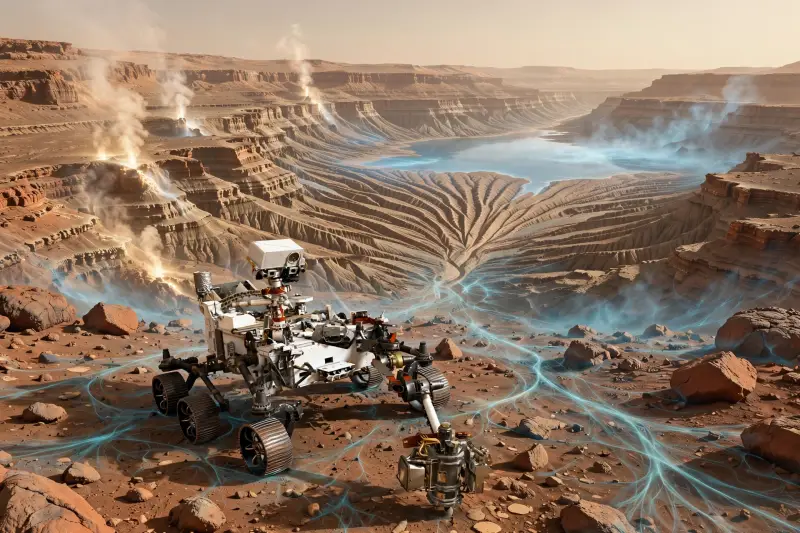
NASA’s Perseverance rover has shown that rocks on the inner rim of Jezero Crater were altered by liquid water on at least three separate occasions. [T] SuperCam mineralogy, published yesterday in Communications Earth and Environment, records carbon-dioxide-rich groundwater making carbonate ridges, a later silica-rich lake episode, and a hotter hydrothermal pulse that left calcium sulfate and fluorite veins. The ages are still unknown. [U] What is no longer unknown is that this shoreline was a crossroads, not a single wet moment.
1. THE BIG DISCOVERIES
[T] THREE WATERS AT JEZERO
WHAT HAPPENED: Perseverance mapped more than 185 SuperCam targets across the Margin Unit. Sequence: CO2-rich groundwater plus olivine formed carbonate-filled fractures; lake-related silica concentrated below a former waterline; later hot fluids deposited centimeter-scale sulfate-fluorite veins.
WHY IT MATTERS: Jezero sits inside one of Mars’s largest carbonate exposures. Multiple chemistries mean multiple habitability windows, not one.
WHAT IT COULD BECOME: A ranked target list for returned samples and for any future in-situ organics work.
WHAT IT MEANS FOR YOU: If life ever started on Mars, it had more than one chance in the same rocks.
[T] A 42-LIGHT-YEAR COSMIC-RAY TAIL
WHAT HAPPENED: China’s Einstein Probe mapped an X-ray tail ~42 light-years long from pulsar PSR J1740+1000, aligned with LHAASO ultrahigh-energy gamma rays. Same particle population, two wavelengths.
WHY IT MATTERS: High-energy particles can keep a preferred direction for tens of light-years instead of immediately isotropizing. [I]
WHAT IT COULD BECOME: A tracer method for PeVatron leakage and Galactic cosmic-ray transport.
WHAT IT MEANS FOR YOU: The “how do cosmic rays get here” problem now has a mapped highway, not only a spectrum.
[T] 3-D CHARNIA IN A NORWEGIAN SHEEP FIELD
WHAT HAPPENED: A ~560-million-year-old Charnia, one of the earliest animals, was found in 3-D in Finnmark turbidites. First confirmed Scandinavian Charnia; first major new European Ediacaran site in decades. Paper in Palaeontology.
WHY IT MATTERS: Soft-bodied Ediacaran animals are usually flat impressions. Volume preservation shows anatomy that 2-D fossils hide.
WHAT IT COULD BECOME: Evidence that early animals were more geographically widespread than the classic sites implied. [I]
WHAT IT MEANS FOR YOU: Complex life left a thicker fossil map than textbooks still draw.
[T] RADIO FROM AN EXOPLANET
WHAT HAPPENED: First radio waves reported from an exoplanet, the ~10-Jupiter-mass world Beta Pictoris b, consistent with a magnetic field thousands of times Earth’s and possible auroras. [T/I]
WHY IT MATTERS: Magnetic fields are a gatekeeper for atmospheres and habitability models.
WHAT IT COULD BECOME: A radio search channel for giant-planet dynamos.
WHAT IT MEANS FOR YOU: Another planet now has a measurable magnetosphere, not only a spectrum and an orbit.
[T] LAB CONCRETE THAT EATS CO2 AND GETS STRONGER
WHAT HAPPENED: A mix with 50 percent zeolite and 1 percent bamboo biochar reached 38.49 MPa compressive strength (+7.48 percent) and 4.39 MPa split tensile (+15 percent), absorbing 1.2 g CO2 per day in a chamber with 15 mm penetration in seven days.
WHY IT MATTERS: Cement is a large emissions source. A denser matrix that also carbonates is useful if it survives field conditions. [U] for scale-up.
WHAT IT COULD BECOME: Incremental carbon-storing structural concrete, not a climate silver bullet.
WHAT IT MEANS FOR YOU: Buildings might someday lock a little carbon instead of only emitting it. Chamber rates are not building rates.
2. SPACE / COSMOS
[T] Simulations reported today indicate smashed icy moons can cool too fast to keep subsurface oceans, tightening which collision histories leave habitable interiors. [I]
[T] Einstein Probe plus LHAASO give the longest known X-ray pulsar-wind tail and a directional cosmic-ray path.
[T] Perseverance’s three-episode water record at Jezero is the week’s strongest planetary result.
[U] Sensational claims of “caves built to shelter life on Mars” outrun the published NASA water paper. Treat shelter-cave headlines as unverified until mapped to a primary dataset.
Equinox timing: September equinox arrives 00:05 UTC September 23. Quiet solar conditions today; a coronal-hole stream may raise aurora odds tomorrow. [T]
3. PHYSICS / QUANTUM
[T] Real-time imaging of a skyrmion lattice melting and reforming through an intermediate phase was reported as a physics lead this cycle. That is condensed-matter observation, not a device demo.
[I] A Chalmers theoretical method claims single-period Floquet control of bosonic codes more than 1,000 times faster than stepwise driving (Physical Review Letters). Hardware confirmation is still required. [U]
[T] Earlier this month, Quantinuum’s H2 won a complement-sampling game with a widening quantum-classical gap up to 55 qubits. Useful as a verification test, not as general advantage for science problems.
Separate observation from inference: quantum jumps of phonons and room-temperature quantum materials were reported in mid-September. They are not today’s papers.
4. AI + SCIENCE
[T] Nature notes AI systems that generate hypotheses, design experiments, and analyze data still require human judgment on what counts as sense. That is an editorial constraint, not a discovery.
[I] Paper2Agent-style tools that turn papers into queryable agents are circulating as a scientific-instrument pattern. Replication quality remains the bottleneck. [U]
No ordinary product launch qualifies for this desk today.
5. ENGINEERING / MATERIALS / ENERGY
[T] Zeolite-biochar concrete: modest strength gain plus chamber-scale CO2 uptake. Field durability, freeze-thaw, rebar corrosion, and lifetime carbon accounting are open. [U]
[T] Nature reports edible batteries inspired by rice paper that powered devices in pigs and later dissolve in the gut. Early biomedical power, not grid storage.
[T] Graphene-oxide nanosheets were shown to steer drying-droplet patterns from spider-web to mosaic geometries. Pattern control, not a new structural material.
[T] Circular mRNA constructs were reported to raise protein yield up to sixfold in cell factories. Biomanufacturing lever, pending process economics.
6. EARTH / LIFE / HUMAN ORIGINS
[T] 3-D Charnia from Finnmark extends the Ediacaran map into Scandinavia and shows early animals can preserve volume in turbidites.
[T] A Pompeii-like volcanic burial under Chile’s Lauca deposits froze a ~22-million-year-old landscape and supports a relatively steady Andean rise in that sector. [I]
[T] Nature: epigenetic editing used chemical tags to shut down hepatitis B DNA lingering in host genomes. Mechanism demonstration, not a licensed therapy. [U] for clinic.
[T] Genetic work on Kerguelen gentoos argues they comprise four species, including one newly recognized. Taxonomy first; ecology second.
[I] Hidden Antarctic subglacial mountains are being linked to early complex-life habitats. Correlation with ice-sheet history is not a completed mechanism.
7. THE PAPER OF THE DAY
Communications Earth and Environment, 21 September 2026: Perseverance SuperCam analysis of Jezero’s Margin Unit.
QUESTION: How many distinct aqueous regimes touched the carbonate-rich inner rim?
METHOD: Mast-mounted spectroscopy of 185-plus rock targets; mineral assemblages ordered by stratigraphic and textural context.
RESULT: At least three water episodes with different chemistries. Ages not constrained. [T] for sequence; [U] for timing.
LIMIT: No returned sample, no absolute dates, no organics claim in this paper. Do not upgrade “water” into “life.”
WHY IT MATTERS: Habitability is a timeline problem. Three fluids in one unit multiply the number of environments that samples must explain.
8. WHY THIS MATTERS TO YOU
Mars news is not souvenir geology. It is a ledger of how long liquid water can persist on a small, cooling world. Cosmic-ray mapping is how we learn whether high-energy particles wander or travel. A 560-million-year 3-D animal is a reminder that the first bodies were already geographically adventurous. Concrete that stores a little carbon is engineering, not salvation. Edible batteries and epigenetic switches are medical tools in the making. None of these require you to change your day. All of them change what is physically on the table.
9. REALITY CHECK
WHAT WE KNOW: Three water chemistries at Jezero. [T] A 42-light-year aligned X-ray and gamma-ray particle trail. [T] A 3-D Ediacaran Charnia in Norway. [T] Chamber-scale stronger, CO2-absorbing concrete. [T]
WHAT WE THINK: Directed cosmic-ray transport is more common than isotropic diffusion models assumed. [I] Early animals were more widespread. [I] Carbonating concretes can be made without losing strength. [I]
WHAT WE DON'T KNOW YET: Dates of the Martian water pulses. [U] Whether icy-moon oceans survive realistic smash-ups. [U] Whether lab concrete carbonation survives decades outdoors. [U] Whether epigenetic HBV shutdown is durable in people. [U]
HYPE WATCH: “Caves perfectly built to shelter life on Mars” and “end of humanity via Yellowstone” are not today’s evidence. Quantum “1,000x” remains theory until a device clock runs the protocol.
CLOSING SIGNAL
If you remember one thing: Jezero’s rim was washed at least three times, by three different waters. Habitability, if it existed there, had more than one appointment.
Add comment
Comments