

Ω NEWS BRIEF
SCIENCE DESK — DISCOVERY REPORT
Friday, September 18, 2026
OPENING SIGNAL
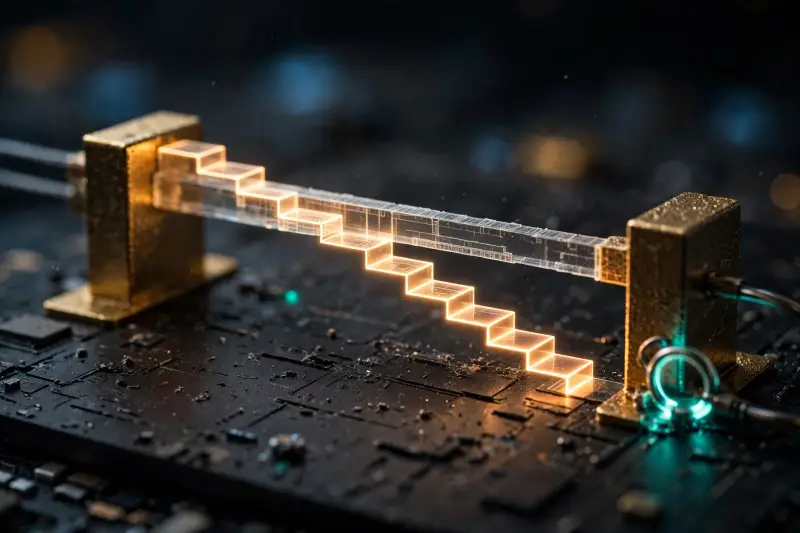
Sound just jumped. [T] A Stanford team published in Science that a lithium niobate mechanical resonator, read out by a superconducting qubit, showed discrete phonon-number jumps in real time — the first direct observation of quantized sound changing energy state rather than fading continuously. Ions did this in 1986. Photons did it in 2007. Massive vibrating objects had not. That is the day’s sharpest measurement, not a metaphor.
1. THE BIG DISCOVERIES
[T] QUANTUM JUMPS OF SOUND CAPTURED IN A CHIP-SCALE RESONATOR
WHAT HAPPENED: Makihara and colleagues coupled a nanomechanical resonator to a superconducting qubit, achieved a mechanical lifetime of 2.1 milliseconds, and used repeated quantum nondemolition measurements to watch a single-phonon state drop to the ground state. Single-phonon heralding fidelity was reported at 85 percent.
WHY IT MATTERS: Conventional motion measurements smear energy into a continuous ring-down. Measuring phonon number, not position, makes the discreteness visible in a macroscopic vibrating object.
WHAT IT COULD BECOME: A practical path for mechanical quantum memories, error-corrected acoustic processors, and sensors that treat sound as a countable resource.
WHAT IT MEANS FOR YOU: Quantum hardware is no longer only light and electrons. Vibration itself can be a qubit-adjacent degree of freedom.
[T] NASA SAYS ROMAN NOW HAS FUEL FOR AT LEAST 22 YEARS
WHAT HAPPENED: After the August 30 Falcon Heavy launch and an August 31 mid-course correction that used about 18 kilograms of hydrazine instead of a 200-kilogram allocation, NASA Goddard stated Roman has propellant for at least 22 years of potential science — more than double the original 10-year fuel plan.
WHY IT MATTERS: Survey telescopes die when fuel, detectors, or budgets fail. Fuel is no longer the first limiter.
WHAT IT COULD BECOME: Two extra decades of dark-energy, microlensing, and wide-field infrared mapping if hardware and funding hold. [I]
WHAT IT MEANS FOR YOU: A public observatory designed to map the dark universe just bought calendar time, not new physics by itself.
[T] YOUNGEST CONFIRMED PLANET: ELIAS 2-24 B, UNDER 1 MILLION YEARS
WHAT HAPPENED: Archival Keck/NIRC2 imaging from 2018 and 2020, plus later analysis, confirmed a Jupiter-class companion sitting in a gap of the Elias 2-24 disk, about 450 light-years away and still accreting. Previous youngest imaged planets were about 5 million years old.
WHY IT MATTERS: Core-accretion models struggled to grow a giant at roughly 50 astronomical units this fast. The planet sits where the gap said a planet should be.
WHAT IT COULD BECOME: A calibration target for how disk gaps map to forming worlds. [I]
WHAT IT MEANS FOR YOU: Planet formation is being watched while it is still unfinished, not reconstructed after the disk is gone.
[T] LRO FINDS A 728-FOOT LUNAR CRATER THAT FORMED IN SPRING 2024
WHAT HAPPENED: Two Science Advances papers report McGetchin crater — about 222 meters wide and 43 meters deep — formed between April 11 and May 22, 2024. It is the largest newly identified impact crater found during the LRO era. Nighttime temperatures in a multi-kilometer halo run about 9 degrees Celsius colder than nearby terrain.
WHY IT MATTERS: Impacts this large on the Moon are estimated on century-class timescales. Before-and-after mapping plus a thermal cold spot give a live case study of how lunar soil is reworked.
WHAT IT COULD BECOME: Better hazard models for surface assets and landing sites. [I]
WHAT IT MEANS FOR YOU: The Moon is not a museum. It is still being hit hard enough to change local thermal properties for miles.
[T] NEW WILDCAT SPECIES NAMED IN BOLIVIA
WHAT HAPPENED: Researchers identified the tilcayo tiger cat as a distinct species — reported as the first new wildcat species in more than a century. Primary species description details remain limited in open briefings. [U] on full genetic and morphological dataset until the paper is read in full.
WHY IT MATTERS: Hidden vertebrate species still exist in surveyed continents.
WHAT IT COULD BECOME: Conservation status revision and range protection. [I]
WHAT IT MEANS FOR YOU: Taxonomy is not finished. Field biology still finds large mammals.
2. SPACE / COSMOS
[T] Roman’s fuel ledger is the operational story of the week. Launch mass came in well below the conservative 9,800-kilogram planning figure; extra hydrazine and a near-perfect first burn stacked years onto the tank. Science still depends on detectors, reaction wheels, and budgets, not propellant alone. [I]
[T] Elias 2-24 b is still embedded in its natal disk and appears to occupy a carved gap, strengthening the planet-gap causal link that ALMA morphology had implied.
[T] McGetchin crater on the Moon’s eastern near side was missed in real time by Earth telescopes and only recovered later in LRO archives. Fresh ejecta and a cold halo are now mapped.
[T] Nature reporting this week also notes Mercury’s long-term contraction is larger than earlier wrinkle-ridge tallies suggested, because later impacts buried some contractional evidence. That is a multi-year geologic revision, not a 24-hour flash.
[H] JWST “little red dots” continue to be modeled as rapidly growing early black holes in radiation-hydrodynamic simulations. Interpretation, not a new spectrum in the last day.
3. PHYSICS / QUANTUM
[T] The Science paper “Quantum jumps of sound” is the demonstrated result: phonon number measured, jumps observed, massive resonator, qubit readout. That is experiment, not a proposal.
[T] ATLAS at CERN previously reported evidence for a rare Higgs path, H to virtual photon plus real photon to dilepton plus photon, at roughly one in 10,000 Higgs decays. Evidence-level, not discovery-level, and a few days older than the 24-hour window.
[I] Controlled muonium beams are being prepared as a route to test gravity with exotic matter. Capability is advancing; the equivalence-principle test itself is still upcoming.
[U] Press items about underground experiments ruling out particular gravity-driven decoherence models need the specific dataset before they are promoted. Limited data in secondary summaries.
4. AI + SCIENCE
[T] Nature published WeatherNext Cyclones, an AI system that forecasts tropical-cyclone track, intensity, and size out to about 15 days, with reported skill gains comparable to a decade of numerical-model progress and now feeding operational centers including the U.S. National Hurricane Center.
[I] That is AI as a scientific instrument: a forecast engine evaluated against storms, not a chatbot product note.
[U] Separate controversy around an OpenAI claim on a Navier–Stokes problem is a credit-and-method dispute in mathematics, not a completed physical discovery. Do not treat it as solved fluid dynamics.
[I] Anthropic’s reported wet lab for AI-driven biology is an industrial capability signal. No peer-reviewed molecule from that lab is in today’s packet.
5. ENGINEERING / MATERIALS / ENERGY
[T] Caltech reported a silicon metasurface that can redirect a light beam in about 74 femtoseconds using another beam — a hardware demonstration of ultrafast optical steering.
[I] Concrete formulations that absorb CO2 while gaining strength appeared in institutional coverage dated today. Treat mix design, scale, and durability as not yet independently audited here. [U] on field performance.
[T] Self-healing hydrogel contact lenses that close scratches under UV were reported across medical and engineering wires. Lab demonstration, not a clinical standard of care.
[T] Roman itself is an engineering object: first NASA flagship designed with a refueling port, now carrying enough onboard fuel that a service call looks distant.
6. EARTH / LIFE / HUMAN ORIGINS
[T] Science Advances reported clumped-isotope work on Tyrannosaurus rex body temperature, adding to the warm-blooded case with human-like temperature estimates. Method-dependent; replication across specimens still matters. [I]
[T] Fossil work this week argues early Homo had largely left tree-climbing by about 1.8 million years ago. One anatomical dataset, not a closed debate.
[T] Human brain organoid tissue transplanted into mice produced extensive integration and is being used as a disease-circuit model. Ethical and translational limits are real; this is a research platform, not a therapy.
[T] Heliconius butterflies show unusually slow aging relative to close relatives. Comparative biology, not a human longevity protocol.
[T] Anak Krakatau’s multi-hour early-September eruption sent ash to about 50,000 feet and disrupted thousands of flights. Observation, not a new volcanic theory.
7. THE PAPER OF THE DAY
Makihara et al., “Quantum jumps of sound,” Science, 17 September 2026.
QUESTION: Does mechanical energy in a resonator change in discrete phonon jumps, as quantum theory requires, or only appear continuous because we measure the wrong observable?
METHOD: A lithium niobate nanomechanical resonator transfer-printed onto a superconducting qubit; strong dispersive coupling; repeated quantum nondemolition phonon-number measurements during a 2.1-millisecond lifetime.
RESULT: Heralded single-phonon states and observed discontinuous jumps between n = 1 and n = 0.
EVIDENCE: Direct time traces of phonon number, not inferred from averaged ring-down.
LIMITATIONS: One architecture, millisecond window, 85 percent heralding fidelity, cryogenic chip-scale object. This is not a room-temperature bell.
WHY IT MATTERS: It closes a century-old loop — quantized jumps now exist for ions, photons, and sound — and gives mechanics a countable quantum handle.
8. WHY THIS MATTERS TO YOU
If you care about instruments, today is about measurement, not slogans. Sound can be counted. A flagship telescope just inherited extra years because a burn was accurate. A planet was caught still eating its disk. The Moon recorded a century-class hit that Earth telescopes missed in real time. Storm forecasts are being scored against live cyclones by a learned model. None of that requires you to buy a gadget this afternoon. It does change what laboratories can build and what missions can keep watching.
9. REALITY CHECK
WHAT WE KNOW: Phonon jumps were measured. Roman’s first correction used a small fraction of budgeted fuel. Elias 2-24 b is confirmed in multi-epoch imaging inside a disk gap and is younger than prior imaged giants. McGetchin crater exists with before-and-after LRO coverage. WeatherNext Cyclones is a published forecast system with operational uptake reported by Nature.
WHAT WE THINK: Giant planets can assemble at wide orbits inside a million years. [I] Roman’s extra years will be scientifically used. [I] Lunar cold spots around fresh craters are a general ejecta-texture effect. [I]
WHAT WE DON'T KNOW YET: Whether mechanical quantum processors beat photonic or superconducting ones at scale. [U] Whether Roman’s detectors and funding last as long as the hydrazine. [U] The precise mass of Elias 2-24 b, independent of disk kinematics. [U] The exact impactor type at McGetchin. [U] Whether CO2-absorbing concrete survives real construction cycles. [U]
CLOSING SIGNAL
Remember this: a vibrating object large enough to machine was watched as its sound dropped by one quantum at a time. That is the day’s fact. Everything else is orbit, crater, disk, or forecast built on top of measurements like that.
Add comment
Comments