

Ω NEWS BRIEF
SCIENCE DESK — DISCOVERY REPORT
Thursday, September 17, 2026
OPENING SIGNAL
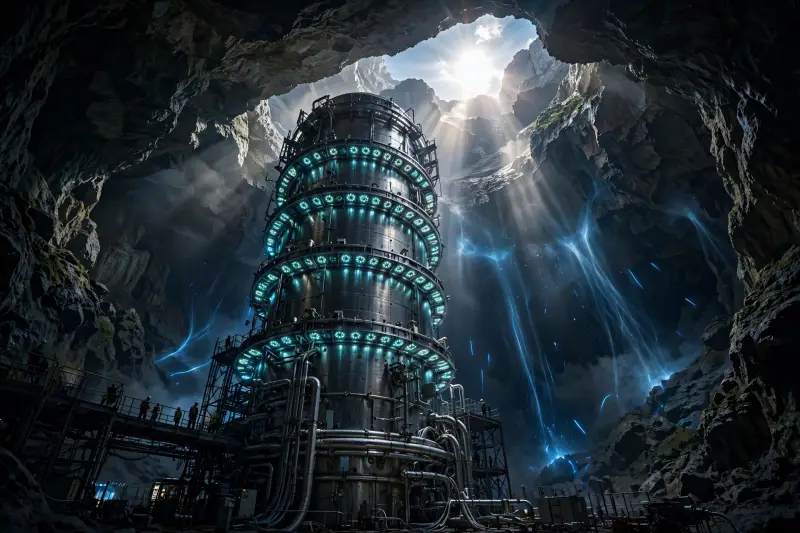
A dark-matter detector just became a solar observatory. [T] The XENONnT liquid-xenon experiment at Gran Sasso reported elastic scattering of solar neutrinos off electrons down to about 17 kiloelectron volts — the lowest neutrino energies yet detected. The signal is dominated by pp neutrinos from the proton–proton fusion that actually powers the Sun, at 5-sigma significance on 2.46 tonne-years of exposure. That is not a press-release hint. It is a new instrument class: rare-event physics hardware now reading the Sun’s core reaction in real time.
1. THE BIG DISCOVERIES
[T] XENONnT sees the Sun’s main fusion neutrinos at record-low energy
WHAT HAPPENED: XENONnT measured neutrino-electron scattering between 1 and 140 keV electron recoil, corresponding to neutrinos as low as ~17 keV — about a tenth the energy of prior direct detections. Borexino’s previous real-time threshold was 335 keV.
WHY IT MATTERS: pp neutrinos carry most of the solar neutrino flux. Seeing them in a xenon TPC built for dark matter shows the same clean detectors can do solar physics, coherent scattering, and WIMP searches in one stack.
WHAT IT COULD BECOME: Next-generation xenon observatories as multi-messenger rare-event labs.
WHAT IT MEANS FOR YOU: The machine that hunts invisible mass is now also a thermometer for the reaction that keeps Earth warm.
[T] Absorption spectroscopy of thorium-229 in CaF2 points to a solid-state nuclear clock
WHAT HAPPENED: A Nature paper this week reports absorption spectroscopy of the 229Th nuclear excited state doped into calcium fluoride — a practical path toward a robust solid-state optical nuclear clock rather than a trapped-ion laboratory curiosity.
WHY IT MATTERS: Nuclear transitions are far less sensitive to the electromagnetic environment than electron clocks. A crystal host can pack many more emitters and, in principle, travel.
WHAT IT COULD BECOME: Compact clocks for navigation, geodesy, and tests of whether fundamental constants drift.
WHAT IT MEANS FOR YOU: Timekeeping that does not need a room-sized vacuum chamber.
[I] New Horizons images interpreted as recent liquid nitrogen on Pluto
WHAT HAPPENED: Reanalysis of 2015 flyby images of northern Sputnik Planitia finds dark linear and diffuse features that resemble wetted glacial ice on Earth. Models allow basal nitrogen ice to melt and rise through conduits. Published in the Planetary Science Journal; NASA and SwRI briefed this week.
WHY IT MATTERS: First claimed evidence of recently expressed liquid on Pluto. Surface age of the glacier is modeled as under about a million years, so the features would be young.
WHAT IT COULD BECOME: A new class of cryovolcanic or basal-melt hydrology on ice dwarfs.
WHAT IT MEANS FOR YOU: The Kuiper Belt is not a museum of frozen fossils. It still moves.
[T] ATLAS reports entanglement of two Z bosons from Higgs decays
WHAT HAPPENED: LHC data show strong evidence that the spins of two Z bosons from Higgs decays are quantum-entangled — entanglement at electroweak-scale masses, published in Physical Review Letters.
WHY IT MATTERS: Entanglement is no longer confined to photons, ions, and superconducting circuits. It is now measured in particles that live for ~10^-25 seconds.
WHAT IT COULD BECOME: A new handle on Higgs quantum information and beyond-Standard-Model spin correlations.
WHAT IT MEANS FOR YOU: “Spooky action” is not a tabletop parlor trick. It survives the collider.
[T] Hubble and JWST add 27 small trans-Neptunian objects
WHAT HAPPENED: Joint visible-plus-infrared survey found 27 new TNOs, some only ~10 km across. Two Astronomical Journal papers cover colors/composition and size distribution.
WHY IT MATTERS: The smallest, faintest outer Solar System bodies are the least processed leftovers of planet formation. Their size spectrum tests how the disk fragmented.
WHAT IT COULD BECOME: A statistical map of the primordial belt, not just a catalog of bright dwarfs.
WHAT IT MEANS FOR YOU: The Solar System’s edge is still being counted, not assumed.
[H] Western Australia impact dated near 3 billion years — oldest crater claim remains contested
WHAT HAPPENED: New mineral dating of shatter-cone-associated zircon and apatite at the North Pole Dome in the Pilbara yields ~3.02 billion years. Earlier 3.47 Ga claims were challenged; a 2025 counter-study argued the impact post-dates 2.77 Ga lavas.
WHY IT MATTERS: A confirmed Archaean crater would be the only well-dated window on bombardment while continents and early life were assembling.
WHAT IT COULD BECOME: Either the oldest impact structure on Earth, or another cautionary tale about shatter-cone stratigraphy.
WHAT IT MEANS FOR YOU: Deep time is evidence-limited. Age tags move when the minerals are actually dated.
2. SPACE / COSMOS
[T] NASA reports confirmation of a “newborn” planet, Elias, as the youngest known world — under a million years — from archival data. [U] Independent mass and orbit details still need full primary-paper scrutiny.
[T] XRISM measured a hot wind from starburst galaxy M82 at about 2 million mph — first direct speed of that superheated outflow.
[I] Nature this week reports JWST little red dots and overmassive early black holes reproduced in cosmological radiation-hydrodynamic simulations. That is simulation confirmation of an observed population, not a new telescope detection.
[T] Roman Space Telescope team powered on the Wide Field Instrument. Hardware checkout, not science first light.
[T] Webb released a large panorama of star-forming region IC 348 and found brown dwarfs down to about twice Jupiter’s mass.
3. PHYSICS / QUANTUM
[T] XENONnT solar-neutrino result, as above. Distinguish from earlier coherent elastic neutrino-nucleus scattering hints: this week’s headline is electron scattering of pp neutrinos at 17 keV.
[T] Nature: electrically controllable superconducting memory effect in UTe2, a leading p-wave superconductor candidate. Stimulus strength and duration write the memory. Demonstrated in the material, not a product.
[I] Lattice QCD calculations report the electroweak force ~1% stronger than phenomenological extractions (PRL / PRD). If it holds, Standard Model tensions get a new number, not a new particle.
[T] First observation of Shapiro steps in ultracold atoms — a Josephson-like quantum staircase now seen in a neutral-atom system.
[T] Telecom-heralded single-photon storage in a spin-rephased absorptive quantum memory reported in PRL — a synchronization piece for long-distance quantum networks.
Do not confuse these with product AI or consumer quantum computing claims. They are laboratory demonstrations.
4. AI + SCIENCE
[T] Nature cover-week paper: WeatherNext Cyclones, an AI system that predicts tropical-cyclone track, intensity, and size up to 15 days. Reported accuracy gain versus leading operational models is described as comparable to a decade of numerical-forecast progress. It is now feeding guidance to the U.S. National Hurricane Center and other agencies. That is AI as a scientific instrument in operational meteorology, not a chatbot demo.
[I] Paper2Agent converts papers, code, and data into tool-using agents that reproduce results and answer queries. Useful if it actually reproduces; [U] field-wide reliability is unproven.
[U] OpenAI Navier–Stokes controversy is credit-and-method noise, not a settled solution of a Millennium Problem. Do not promote it above [P]/[U].
5. ENGINEERING / MATERIALS / ENERGY
[T] UV-triggered self-healing polymer hydrogel contact lenses reported — scratches repair after about an hour of UV. Lab materials result; durability, oxygen permeability, and regulatory path are open.
[T] Argonne-led team reports a nickel sulfide that can switch between quantum states — a rare, tunable condensed-matter knob.
[T] Controlled cracking used to print quantum-dot pixels for sharper displays — a manufacturing trick, not a new physics law.
[I] Catalyst claiming 75% less platinum in hydrogen fuel cells: promising if lifetime and current density survive outside the press release.
[T] Nature also describes heterogeneous photonic integration of single-crystal nanomembranes onto silicon/silicon-nitride photonics for efficient electro-optic and magneto-optic modulation.
6. EARTH / LIFE / HUMAN ORIGINS
[T] PKCβ structure solved after four decades, opening a concrete drug-target geometry.
[I] Mouse work: a skull-resident immune niche acting as a fast responder against brain cancer. Mechanism is local immunity, not a newly invented human organ. Translation is [H].
[T] Cambrian fossil Yujingia suggests ambulacrarians (echinoderms and hemichordates) evolved from a tentaculate, semi-sessile suspension feeder.
[I] Lebanese fossil assemblages show Mediterranean woodlands persisted ~400,000–100,000 years ago along the Levantine coast, with seasonal hominin hunting by habitat.
[H] 240-million-year-old Tanzanian dicynodont tied to South American groups; used to argue some “earliest dinosaur” beds are younger. Stratigraphic implication, not a new dinosaur species headline.
7. THE PAPER OF THE DAY
XENONnT solar pp neutrinos via electron scattering — collaboration announcement and supporting preprint, Gran Sasso / XENON, 2026.
QUESTION: Can a tonne-scale liquid-xenon dark-matter TPC see the lowest-energy solar neutrinos, the ones from the Sun’s dominant fusion channel?
METHOD: 5.9 tonnes of ultrapure liquid xenon; first two science runs, 2.46 t·y; electron recoils 1–140 keV; aggressive 222Rn/214Pb background control plus dedicated calibrations.
RESULT: First observation of low-energy solar neutrinos by electron scattering in a dark-matter detector; threshold ~17 keV; 5-sigma; flux dominated by pp neutrinos.
EVIDENCE: Statistical threshold met; background model constrained; energy scale calibrated. This is [T] for the detection claim.
LIMITATIONS: Not a precision solar-model test yet. Flux extraction still carries detector-response and atomic-effect systematics. It does not discover dark matter. It does not replace Borexino’s spectroscopic program overnight.
WHY IT MATTERS: The cleanest shields on Earth now read the reaction that lights the day.
8. WHY THIS MATTERS TO YOU
Three machines moved this week: a xenon tank under a mountain, a thorium-doped crystal, and a cyclone model now in forecast offices. One tells you what the Sun is doing in its core. One aims at clocks that could leave the lab. One is already in the path of storms. None of this requires you to buy a gadget today. It does change what “precision” and “warning time” can mean within a decade if the results replicate and engineer.
9. REALITY CHECK
WHAT WE KNOW: XENONnT detected low-energy solar neutrinos by electron scatter. ATLAS sees Z-pair entanglement in Higgs decays. Hubble/JWST added small TNOs. Nature published Th-229 crystal spectroscopy, UTe2 memory, and WeatherNext cyclone skill claims.
WHAT WE THINK: Pluto’s dark glacier marks are wet nitrogen from below. Electroweak coupling may be slightly stronger than older phenomenological numbers. Pilbara impact is Archaean and older than Yarrabubba if the new mineral dates hold.
WHAT WE DON'T KNOW YET: Whether Pluto’s liquid is episodic now or only geologically recent. Whether the Pilbara crater is 3.0 Ga or younger than 2.7 Ga. Whether nuclear-clock reproducibility reaches 10^-18 in a field device. Whether WeatherNext’s decade-equivalent gain survives a full independent hurricane season. Dark matter remains unseen in the same xenon that just saw the Sun.
CLOSING SIGNAL
If you remember one thing: the detector built to catch the Universe’s missing mass just measured the fusion reaction that runs the star you live under — at energies no neutrino experiment had reached before.
Add comment
Comments