

Ω NEWS BRIEF
SCIENCE DESK — DISCOVERY REPORT
Tuesday, September 15, 2026
OPENING SIGNAL
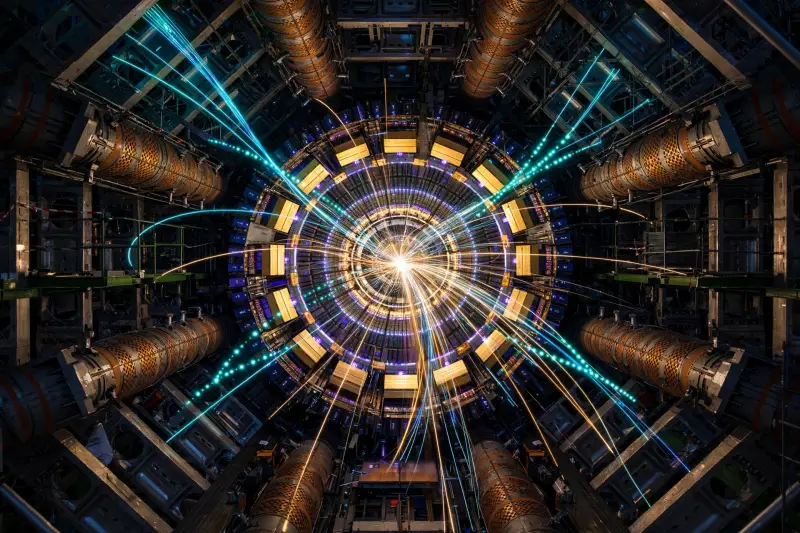
At CERN’s ATLAS detector, physicists have reported strong evidence that two Z bosons born from a Higgs decay are quantum-entangled — including a virtual, off-shell partner. [T] The most sensitive test rejects a separable-state hypothesis at 4.7 sigma. This is not a lab-table photon pair. It is entanglement at electroweak energies, in massive spin-1 qutrits that live for a sliver of a second. If it holds under more data, quantum information is not a low-energy specialty. It is part of the Standard Model’s machinery.
1. THE BIG DISCOVERIES
[T] Entanglement measured in Higgs-born Z bosons
WHAT HAPPENED: ATLAS reconstructed angular distributions from H → ZZ* → four leptons in 13 and 13.6 TeV proton-proton data and extracted spin-density-matrix coefficients consistent with Standard Model entanglement. A likelihood-ratio test using the full angular distribution disfavored a non-entangled hypothesis at 4.7 observed sigma. Source: Physical Review Letters, published 11 September 2026.
WHY IT MATTERS: Previous collider entanglement claims involved top quarks. This is the first strong evidence for entanglement between massive vector bosons treated as qutrits, and it includes an off-shell Z.
WHAT IT COULD BECOME: A template for high-energy tests of quantum foundations and a new use of the Higgs as a controlled entanglement factory.
WHAT IT MEANS FOR YOU: The “spooky” part of quantum mechanics is now being stress-tested at trillion-electron-volt scales, not only in tabletop optics.
[T] Vega-C puts FLEX and Sentinel-3C into orbit
WHAT HAPPENED: ESA’s Vega-C launched from French Guiana on 15 September 2026, placing FLEX and Copernicus Sentinel-3C into sun-synchronous orbit. [T] FLEX is built to map plant fluorescence — the faint red glow of photosynthesis — as a stress diagnostic. Sentinel-3C continues ocean, land, ice, and atmosphere monitoring.
WHY IT MATTERS: Photosynthesis stress can show up in fluorescence before leaves look sick from the ground.
WHAT IT COULD BECOME: Earlier drought, heat, and crop-failure maps feeding climate and food-security models.
WHAT IT MEANS FOR YOU: Better satellite warning of plant stress is a practical climate tool, not an abstract mission patch.
[T] Mercury’s shrinkage was underestimated
WHAT HAPPENED: A Geophysical Research Letters analysis led by DLR finds crater debris hid wrinkle ridges used to measure cooling-driven contraction. Correcting for surface roughness raises total diameter loss by about 10–30 percent, up to roughly 19–23 km across Mercury’s history. [T]
WHY IT MATTERS: Contraction is a thermometer for the interior. The new number sits closer to thermal-evolution models.
WHAT IT COULD BECOME: Sharper constraints on core size, light-element content, and initial heat. BepiColombo’s higher-resolution maps later in 2026 can test the correction.
WHAT IT MEANS FOR YOU: The nearest rocky world is still changing shape. Planetary “deadness” is a story, not a measurement.
[T] Interstellar comet 3I/ATLAS is nitrogen-rich
WHAT HAPPENED: WEAVE observations of the plasma tail detected N2+, CO+, CO2+, H2O+, and CH+. The N2+/CO+ ratio implies N2/CO greater than 0.023, high compared with typical Solar System comets, pointing to ice formation at or below about 30 K. [T] Paper: Monthly Notices of the Royal Astronomical Society.
WHY IT MATTERS: Only the third confirmed interstellar visitor now carries a chemical thermometer from another disk.
WHAT IT COULD BECOME: A comparison sample for how outer-disk ices form around other stars.
WHAT IT MEANS FOR YOU: Material that never belonged to the Sun is now a laboratory object passing through our neighborhood.
[T] FAST releases 156,411 extragalactic hydrogen sources
WHAT HAPPENED: FASHI DR2 maps about 19,500 square degrees and catalogs 156,411 HI galaxies at z less than 0.09. [T] The HI mass function is constrained down to about 10^6.2 solar masses; local cosmic HI density is reported as Ω_HI = (4.71 ± 0.03 stat ± 0.40 sys) × 10^−4 h_70^−1.
WHY IT MATTERS: Neutral hydrogen is the fuel tank of star formation. This is now the largest single-dish HI catalog, several times ALFALFA.
WHAT IT COULD BECOME: A bridge data set for the Square Kilometre Array era and a better census of faint, gas-rich dwarfs.
WHAT IT MEANS FOR YOU: The map of “where galaxies keep their unused gas” just got much less incomplete.
[T] Quantum processor shows inelastic particle production in a field theory
WHAT HAPPENED: Nature Physics reports a 104-qubit digital simulation of 1D Ising field theory. Two light-particle wavepackets collide; energy-density skewness is used as evidence of an inelastic channel producing a heavier particle. Up to 5,589 two-qubit gates. [T]
WHY IT MATTERS: High-energy inelastic production is a core QFT process. Seeing a signature on hardware is a methods result, not a collider replacement.
WHAT IT COULD BECOME: A path to controlled studies of out-of-equilibrium particle production before analog gravity or lattice QCD become tractable.
WHAT IT MEANS FOR YOU: Quantum computers are starting to act as instruments for field theory, not only as bigger calculators for chemistry.
2. SPACE / COSMOS
FLEX and Sentinel-3C are on station after a successful Vega-C flight. [T] Mercury’s revised contraction tightens interior models ahead of BepiColombo science. [T/I] 3I/ATLAS looks like a cold, N2-rich interstellar ice body. [T] FAST’s HI atlas is now the default local-universe gas catalog for half the sky. [T] Limited data on other claimed “new physics” cosmic-ray or magnetic-field anomalies this week; treat those as [U] until primary analyses appear.
3. PHYSICS / QUANTUM
The ATLAS ZZ* result is the week’s highest-energy quantum-information measurement. [T] It is evidence, not a five-sigma discovery, and the most sensitive test still leans on Standard Model decay assumptions. [I] Separate work this month includes digital QFT scattering on 104 qubits [T], Fourier-limited coherence of a single molecule on a crystal surface [T], and a complement-sampling game claiming unconditional quantum advantage on trapped-ion hardware [T/I — hardware noise remains the practical caveat]. Distinguish demonstration from interpretation: entanglement at the LHC is a correlation measurement reconstructed from decay products, not a loophole-free Bell test.
4. AI + SCIENCE
The scientifically relevant AI item this window is not a chatbot launch. It is the use of a digital quantum processor, with a W-state–style wavepacket preparation, to extract an inelastic-production signature in a field theory. [T] OpenAI’s reported Navier–Stokes write-up from 8 September remains [U] as a Millennium-problem solution: secondary coverage is loud; independent verification and credit assignment are unresolved. Do not treat model-generated proofs as settled mathematics.
5. ENGINEERING / MATERIALS / ENERGY
Nickel-oxide methane catalysis appears to involve a hidden surface atomic structure rather than the textbook mechanism. [T/I] A few-atoms-thick material previously treated as nonmagnetic is showing an unexpected magnetic response. [T] Reports of a molecular-level oil-refining process claiming large energy cuts, plant-based rare-metal extraction from lithium waste, and a fourfold fuel-cell power jump are institutionally sourced but need independent process data before they leave [I]/[U]. FLEX itself is an engineering instrument: a fluorescence mapper designed to turn a faint biological photon budget into an operational Earth product.
6. EARTH / LIFE / HUMAN ORIGINS
Ancient DNA indicates plague was already killing Siberian hunter-gatherers about 5,500 years ago, before urban flea-driven pandemics. [T] Diplodocus fossils are reported outside North America, in Spain. [T] Spanish blue-violet amber continues to yield a dense Cretaceous assemblage. [T] A 271-day gene-edited pig kidney in a living human recipient, used as a bridge to a human transplant, is a major xenotransplantation data point from earlier this month. [T] Deep coral off Benin, long written off, was found alive below 50 meters. [T] Screwworm’s return to the U.S. livestock map is an epidemiological fact with immediate agricultural risk. [T]
7. THE PAPER OF THE DAY
Measurements of Z-Boson Pair Entanglement in Decays of Higgs Bosons at the ATLAS Experiment. Physical Review Letters 137, 111804 (11 September 2026).
QUESTION: Do the two Z bosons from H → ZZ* share an entangled spin state at collider energies?
METHOD: Reconstruct four-lepton events; measure angular observables tied to spin-density-matrix elements; compare coefficients with Standard Model entangled predictions; run a complementary likelihood-ratio test against a separable hypothesis.
RESULT: C_{2,1,2,−1} = −0.71 ± 0.45 and C_{2,2,2,−2} = 0.08 ± 0.44, consistent with the Standard Model. The full-distribution test disfavors separability at 4.7 sigma observed (4.9 expected). [T]
LIMITATIONS: Statistics still dominate the coefficient uncertainties. The highest-sensitivity test assumes Standard Model features in the decays. This is not a device-independent Bell inequality. One of the Z bosons is off-shell; interpreting that as “virtual particles carry entanglement” is [I], not a completed ontology.
WHY IT MATTERS: It moves entanglement from atomic and photonic benches into the electroweak sector and treats massive spin-1 particles as qutrits.
8. WHY THIS MATTERS TO YOU
Three instruments changed what can be measured this week: a collider that treats the Higgs as an entanglement source, a radio dish that counted more than 156,000 gas-rich galaxies, and a plant-fluorescence satellite that watches photosynthesis under stress. Those are capability shifts. Mercury’s extra shrinkage and 3I/ATLAS’s nitrogen ice are reminders that even nearby worlds and passing debris still rewrite formation models. Xenotransplantation’s 271-day bridge and plague DNA from pre-city Siberia are human-scale: organs and pathogens have longer, stranger histories than hospital timelines imply.
9. REALITY CHECK
WHAT WE KNOW: ATLAS reports 4.7-sigma evidence, not a formal discovery, for ZZ* entanglement. [T] FLEX and Sentinel-3C launched. [T] FASHI DR2 exists as a public catalog. [T] 3I/ATLAS ion ratios favor cold N2-rich ice. [T] Mercury contraction estimates rose after a roughness correction. [T]
WHAT WE THINK: Off-shell Z entanglement may force a more careful language for virtual particles. [I] FAST’s low-mass HI slope will reshape dwarf-gas budgets. [I] FLEX fluorescence will become an operational drought indicator within a few seasons if calibration holds. [I]
WHAT WE DON'T KNOW YET: Whether ATLAS will cross 5 sigma with Run 3 statistics. The exact core composition implied by Mercury’s extra shrink. The parent system of 3I/ATLAS. Whether AI-generated Navier–Stokes arguments survive refereeing. Replication status of several materials and refining claims circulating from single-lab releases. [U]
CLOSING SIGNAL
If you remember one thing: quantum entanglement is no longer only a low-energy laboratory effect. ATLAS has now measured it in massive Z bosons born from the Higgs — close to discovery threshold, at the energy scale that built the Standard Model.
Add comment
Comments